

Architecture
Deep-dive notes for contributors. For the high-level picture and the system overview diagram, see the README.
The core problem
ccmux exists to bridge a fundamental gap: AI agents running in tmux panes are observable but not addressable from outside. A ps listing tells you “claude is alive in pane %12,” but it can’t tell you which Claude session UUID that maps to. Claude doesn’t keep its JSONL log file open, so lsof won’t link the PID to a log path. Codex, Cursor, OpenCode, Pi, and Antigravity each have their own variant of the same opacity.
The daemon merges three signals to derive per-session state, in order of trust:
| Signal | Source | Confidence |
|---|---|---|
| Hook markers | ~/.config/ccmux/session-pids/*.json (written by hook scripts / plugin) |
High. Agent-emitted lifecycle events. |
| JSONL log entries | tailed log files, fed into the status machine | High. Exact tool calls, results. |
| Terminal patterns | regex over last 30 lines of tmux capture-pane |
Low. Pattern-based, can miss scrolled-off prompts. |
Status detection cascade
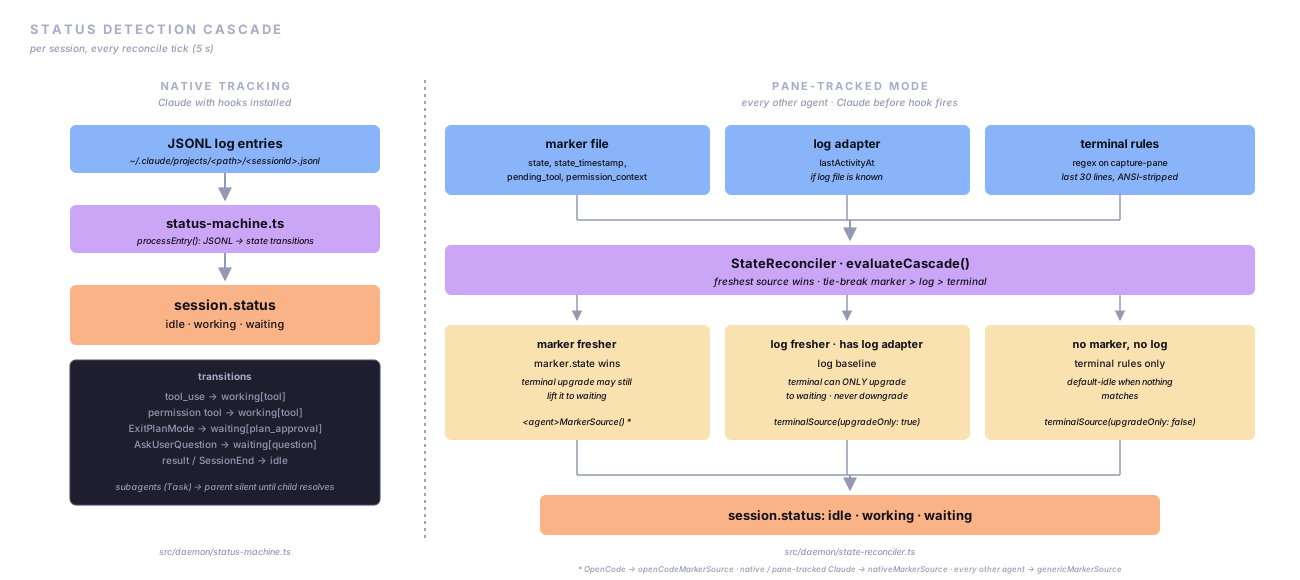
ccmux runs each session through one of two tracking modes per tick.
native is Claude only. The session has a real nativeSessionId (UUID), a known JSONL log file the daemon tails (LogWatcher), and a status state machine (status-machine.ts) that consumes log events: assistant tool_use becomes working[tool] (including tools that would require permission — see below); ExitPlanMode becomes waiting[plan_approval]; AskUserQuestion becomes waiting[question]; result entries and SessionEnd become idle. Subagents (Task tools) flip the parent to silent-working until the child resolves. The state machine does NOT derive a waiting[permission] from a tool_use: Claude Code writes a permission-gated tool_use to the transcript only AFTER the user resolves the prompt (verified against Claude Code 2.1.214), so a tool_use we can read has already been approved and is executing. Deriving waiting from it would only phantom-fire under auto-accept/bypass modes; genuine permission prompts reach the row via the Notification-hook marker (waiting_permission) instead. See the subagent-tracking note below for the full rationale.
pane-tracked is every other agent, plus Claude before its hook fires. The session is identified by tmux pane (synthetic ID like codex_pane963). Status comes from terminal scanning, hook markers (if installed), and log entries (if available).
Both modes converge on a single pure fold: evaluateCascade() in cascade-evaluator.ts. The reconciler builds a CascadeSource[] from whatever signals are available for the session (marker, log adapter output, terminal rules), and the evaluator picks the freshest one. Each source carries:
- a candidate
CascadeState(status, attentionType, pendingTool), - a timestamp,
- a tie-break priority (
marker > log > terminal), - an
upgradeOnlyflag.
upgradeOnly sources can lift the result to waiting but never downgrade. This is how a stale terminal-detected waiting still catches a transient permission UI even when logs say “idle”, and how logs holding working survive a brief moment when the visible 30 lines don’t contain ccmux’s patterns. When two sources tie on timestamp, the priority order resolves the conflict.
Per-tick the reconciler assembles a slightly different source set:
- Pane-tracked (
reconcilePaneTrackedAgentSession):terminalSource()(default-idle baseline),genericMarkerSource()if a marker exists,logSource()if a log adapter exists. OpenCode usesopenCodeMarkerSource()to fold its multi-session aggregation in. - Native Claude / Codex (
reconcileNativeCascadeSessions):nativeLogSource()(the status-machine output) plusnativeMarkerSource()if a marker is present, with a targeted pane capture providing anupgradeOnlyterminal source for stale “working” sessions (disambiguates “still going” from “stuck on plan approval”).
A safety net: if the process PID is unknown (off-path session, crashed parent), log-file mtime caps a stale “working” to idle after 10 minutes (status-machine.ts).
Retiring a spent permission marker. Escape on a Claude permission prompt fires no hook, so the marker keeps claiming waiting_permission, and on the native path nothing could contradict it: nativeLogSource() echoes the stored waiting back at the marker’s own timestamp every tick, so it ties the marker rather than out-freshening it, and the tie resolves to the marker. Only a source stamped now can win. The stale-session pane check, meanwhile, only looks at sessions that are working. The row sat at waiting until the next real turn, refusing every handoff (issue #117). The fix reads the pane the native path already captures while a marker claims a permission wait, and for a session the store still shows as waiting whose marker is older than STALE_PERMISSION_GRACE_MS (30s, covering the draw of the prompt that marker is about), a POSITIVE observation of an empty composer with no prompt under it (showsIdleClaudeComposer, pane-classify.ts) enters the fold as a baseline terminal source stamped now. That is the one place a terminal observation may lower a marker’s waiting. Positive, not “no permission pattern matched”: Claude’s permission prompt matches none of its own terminal rules, so absence of a match is not absence of a prompt. The waiting-only gate is what keeps this a ONE-SHOT correction rather than a pin, and it is load-bearing for a second reason: Claude keeps its composer on screen while it WORKS, so the composer proves no prompt is up and nothing more. A keyboard approval leaves an identically stale marker behind a log that says working, and there the log is already right. Everything else ambiguous keeps the row waiting too (a composer with typed text in it, a prompt rendered below the last composer line, an unreadable pane), because a slow row is recoverable and a cleared attention indicator is not.
Process discovery (processes.ts)
Every scan tick lists processes with ps, matches each command line against the agent defs, then resolves the survivors’ cwd and tty — from procfs, or from one batched lsof where there is no procfs. The tty is what makes a process bindable — the binder matches it against the pane’s tty — so a process without one never becomes a session, and a process without a cwd is skipped by the binder just as surely.
Where the cwd and the tty come from is platform-dependent, expressed as a DiscoveryPlatform record chosen once, whose cwdSource is the whole of that choice. macOS leaves tty out of the ps columns and harvests it from the fds of lsof -a -p <pids> -d cwd,0,1,2 -Ffn, because BSD ps builds a full device-name table whenever the column is requested (~136ms vs ~55ms on a 1200-process machine; narrowing to specific pids doesn’t avoid it) — and there is no procfs to read a cwd out of, so lsof runs regardless. Everywhere else ps keeps the column and each cwd is one readlink("/proc/<pid>/cwd"), so discovery never spawns lsof at all: lsof is not installed by default on several distros (observed live on Arch), and when it was the only cwd source a missing binary left every row with cwd: null — silently, since the binder skips a cwd-less process (binder/primitives.ts, binder/migrate.ts), so the daemon tracked zero sessions indefinitely while agents ran. Both records feed the same parse-and-fold, so the platform choice never spreads past that one value — and every flag in the lsof invocation is load-bearing in a way that fails silently when undone (-a, exactly fds 0/1/2, the f field selector). Each is documented at its definition in processes.ts; read those before editing an invocation.
Making lsof the tty source makes it fail-closed too. On macOS a dead lsof means every row takes tty: null and is filtered away, so discovery would return [] — indistinguishable from “no agents are running”, the one answer the scan loop acts on destructively (wipe every session, delete every marker). So batchGetProcessFdInfo separates lsof ran from lsof did not: a non-zero exit that still carried records is the routine case (a pid died between ps and the lsof call) and degrades to a few dropped rows, while a spawn exception or a non-zero exit with nothing parseable raises ProcessDiscoveryError and skips the cycle. The procfs arm has no such batch failure to fail closed on, by construction: each pid is its own readlink, and one that can’t be read (EACCES on another user’s process, ENOENT for a pid that raced away or went zombie) costs that row’s cwd and nothing else. A (deleted) suffix is stripped rather than dropped, so a worktree removed and recreated at the same path keeps its process bindable. The residual single-row case — either source succeeding but omitting one live process — is absorbed downstream by two-scan hysteresis in both session cleanup (binder/cleanup.ts) and marker cleanup (cleanupStaleMarkers).
Filter order after cwd resolution is load-bearing too: drop the tty-less → drop codex plugin hosts by cwd → dropWrapperParents. The plugin host must go before wrapper dedup (it is a same-tty child of the real codex, so it would evict its own parent), and the tty filter is what keeps pipe-stdio processes — subprocess-mode invokes like codex exec, MCP servers, language servers — from becoming phantom rows on the pane the daemon happens to be running in.
Session-to-pane binding (the binder)
A session (a discovered agent process, or a hook marker) has to be pinned to the tmux pane it lives in before the TUI can route you there. binder/ (scan.ts, assign.ts, migrate.ts, links.ts, cleanup.ts, primitives.ts, …) owns that policy; session-pane-match.ts is a thin I/O wrapper — matchSessionsToPanes snapshots sessions + markers, calls decideScanBindings, and applies the emitted bindings to the real SessionManager.
Marker claims settle first, across all panes, and are authoritative — re-asserted every scan, so a mis-bind heals. Only then do the heuristic arms run over the post-marker state. scan.ts drives the per-scan ladder (marker → pane-holder → live-pid arms) on working copies that simulate the SessionManager setter semantics.
For panes no marker claims, each same-cwd group of sessions and candidate panes is solved as one small optimal assignment (assign.ts), gated by three guards:
- D1 — direction skew: a session’s timestamp may precede its process start by at most a small skew.
- D2 — tolerance cap: a match beyond 600s of separation is rejected.
- D3 — ambiguity refusal: a near-tie leaves the row visibly unbound rather than guessing.
“Pane timestamp” survives only as the boot-migration fallback (migrate.ts), for procs whose ps etime start time is unparseable. There is no “most recent file” arm.
Joining a process to a pane: tty, then ancestry. pairProcsWithPanes (binder/primitives.ts) is the single process↔pane join, and every site goes through it: the per-scan re-bind, transcript-driven Claude creation, the initial batch, boot migration, marker resolution (findPaneByMarker’s third pass), and pane-tracked creation. Pass one matches the process’s tty against the pane’s, as it always did. Pass two exists for pty-allocating wrappers — script -q /dev/null claude, nono run -- claude, fence — which fork, keep the pane’s tty for themselves, and setsid the agent onto a fresh pty that no pane owns; the agent was discovered, found no pane, and was discarded, so the row never appeared (issue #193). For those, the pane’s own panePid is walked down through the ProcessTree to the agent.
Ancestry is strictly subordinate to tty and never fires for a process without one:
- A pane a tty match already claimed is never re-claimed by ancestry, so a wrapper-hosted agent will not evict the agent that genuinely owns the pane’s terminal (it stays visibly unbound instead).
- A process with no tty is skipped. Discovery already drops those rows (a pipe-stdio subprocess —
codex exec, an MCP server), so this is a defensive restatement rather than the filter that does the work: it keeps the rule true for any caller that assembles its own process list. - One pane resolves at most one process by ancestry, and one process is claimed by at most one pane. A pane whose pid flip-flops between two candidates trips the pane-reuse identity reset every cycle (
processes.ts:dropWrapperParents), which is also why the join is shared: creation and the per-scan re-bind cannot disagree about the same wrapper shape.
The accepted trade-off. Ancestry binds ANY orphan pty that descends from a pane’s shell, not only a wrapper’s. Run kitty & (or alacritty &) from a pane and then start an agent inside that new window, and the agent’s ppid chain still leads back to the launching pane, so its row is attributed there — a real window, the wrong pane. This is the cost of not requiring the wrapper to be recognizable: script, nono and fence match no agent def and share no tty with the agent, so ancestry is the only evidence left. Such a binding is not sticky: it drops the moment a real agent takes the pane’s own tty (tty wins), and comes back when that agent exits.
Tty ownership is reserved even when the owner’s cwd cannot be read. Pane-tracked creation pairs all discovered agents before excluding hooks-mode Claude, so Claude still prevents an unrelated pty from claiming its terminal. The tty-claimed set is scoped to the supplied processes; the Claude-only ladders cannot account for other agents’ tty claims. The creation sites build their own ProcessTree rather than reusing the scan’s cached one: a marker fires the instant an agent starts, and a tree from up to one scan interval ago has no node for it. That is one ps per new session, never one per scan tick.
If a sandbox denies writes to ~/.config/ccmux, the agent cannot write its hook marker. Claude with hooks installed remains natively tracked and relies on its transcript for status, with no terminal-pattern fallback. Other agents retain their available log and terminal status sources.
Log tree watching
log-tree-watcher.ts is the recursive-fs.watch-backed substrate behind LogWatcher for the agent log trees (~/.claude/projects, ~/.codex/sessions). It exists because chokidar arms one watcher per directory, and that setup alone cost seconds of daemon boot on session-heavy machines.
Platform event names are unreliable and FSEvents coalescing is stream-local, so events are classified by stat + a known-files set, and every event reconciles a subtree (walk for new files, sweep for gone ones). ready is deferred ~50ms to cover the stream’s arming window. It falls back to chokidar when the root is missing or recursive watching is unsupported.
Watching is not the whole append story. An adapter sets pollsLog (LogAdapter, Codex only today) when its agent holds the log’s file descriptor open for the life of the session: macOS emits no change event for appends made through an open fd, so ~/.codex/sessions is watched for new and removed rollouts but is silent about the writes into them. LogWatcher stat-polls those adapters’ linked log files once a second (LOG_POLL_INTERVAL_MS, src/daemon/watcher.ts) and dispatches the grown ones through the same debounce a real change event uses, so the polled and event-driven feeds stay one code path.
Multiple Claude config dirs
Claude Code writes transcripts to $CLAUDE_CONFIG_DIR/projects, so a second account (a work login in ~/.claude plus a personal one under CLAUDE_CONFIG_DIR=~/.claude-personal) lands in a separate tree. resolveClaudeProjectDirs (lib/config.ts) collects ~/.claude plus every dir from the additionalClaudeConfigDirs preference and CLAUDE_CONFIG_DIR (deduped, primary first). The daemon stands up one ClaudeLogAdapter + LogWatcher per tree — the same fan-out shape as one-adapter-per-agent — all feeding the shared SessionManager. Empty unless configured, so default single-dir behavior is unchanged. Only extra trees add watchers; the primary ~/.claude/projects watcher stays authoritative for marker-driven, path-agnostic processPath routing, and buildLogPath probes every tree to locate a session’s transcript.
Because a transcript lives in exactly one tree, marker events route to the watcher that owns the session: LogWatcher.ownsSession(id) reports whether that tree has discovered the session’s log, and the Claude adapter’s ownerFor (getLogWatchers("claude") → find(ownsSession) ?? watchers[0]) picks the owning watcher, falling back to the primary for sessions no tree has discovered yet (e.g. a marker written before the first turn). For the same reason, per-watcher freshness state (isRecentlyProcessed) is folded across all Claude watchers in the reconciler, so a second-account session isn’t invisible to the just-processed debounce guard.
Subagent tracking (Claude)
Claude Code writes per-subagent transcripts to <projects>/<encoded>/<sessionId>/subagents/agent-*.jsonl; ClaudeLogAdapter owns a private chokidar instance for that layer and folds each file’s derived state into Session.subagents. Each entry also carries startedAt, read once from the transcript’s first entry (readFirstEntryTimestamp) and carried forward; the head is immutable, so re-reads after eviction or a daemon restart derive the same value. The preview renders it as runtime-since-spawn, the same clock Claude’s own agent panel shows; staleness detection stays on lastActivityAt. getEffectiveStatus (used by every TUI consumer) then lifts the parent: any active subagent (working or waiting) lifts an idle parent to working (rendered as “agents”), so a lead sitting at its prompt never renders as done while its agents run. A subagent’s waiting deliberately does NOT surface as row-level waiting: it is log-derived from an unresolved tool_use, which a tool mid-execution and a genuine approval prompt exhibit identically, so it would false-alarm under bypassPermissions. The same reasoning removed log-derived permission waiting from the MAIN transcript (processAssistantEntry): Claude Code defers writing a permission-gated tool_use to the transcript until AFTER the user resolves the prompt (verified against Claude Code 2.1.214), so any such tool_use the daemon reads is already approved and executing. Inferring waiting from it phantom-fired “Needs permission” notifications for the tool’s whole run under --dangerously-skip-permissions, in-session auto-accept, and defaultMode: "auto", with no prompt on screen. Genuine permission prompts surface in the lead’s own pane and reach the row through the higher-fidelity signals: the Notification hook flips the marker to waiting_permission for native sessions, and the terminal detector reads the prompt off the pane for pane-tracked ones.
Subagents come in two flavors with different lifecycles, and the adapter must handle both:
- Blocking
Tasktools: the parent transcript records the tool_use, so the status machine tracks pending task IDs (hasActiveSubagent), and the subagent’s own log ends withend_turn(it self-reports idle, and idle entries self-evict viaSessionManager.updateSubagent). - Background teammates (
Agenttool,taskKind: in_process_teammate): the tool_result acks in milliseconds and the parent ends its turn, so the parent log carries no subagent bookkeeping, and the teammate’s transcript never records a terminalend_turn. Filenames embed the agent name (agent-areviewer-functionality-<hex>.jsonl), not just hex.
That forces four design points:
- Discovery keys off the directory, not the parent log: the adapter attaches when
hasActiveSubagentis set or when anyagent-*.jsonlin the subagents dir was written withinSUBAGENT_STALE_TIMEOUT_MS(probe result cached ~15s, since parent parses are frequent). - Evaluation cannot be parse-driven alone: parent log parses stop at
end_turn, and teammates often start writing only after the parent’s last parse (verified live).LogAdapter.onReconcileTick, called fromtickLogAdaptersevery reconciler scan, re-evaluates attach/teardown independent of parent activity. - Completion is inferred from silence: the reconciler’s
capStaleSubagentssweep downgrades active (workingorwaiting) subagents whose logs have been silent pastSUBAGENT_STALE_TIMEOUT_MS; the downgrade to idle also removes the entry. The threshold is deliberately generous (a subagent inside one long Bash call appends nothing while genuinely working). - Teardown requires all signals gone: the dir watch is dropped only when the subagents array is empty, the parent has no pending tasks, and the dir is inactive. The parent reading
idleis explicitly not an exit signal — it’s the normal background-agent state. Sharing the staleness threshold between the attach probe, the seed cap (capStaleSubagentSeedon re-attach seeding), and the sweep is what prevents attach/teardown loops.
Hook lifecycle
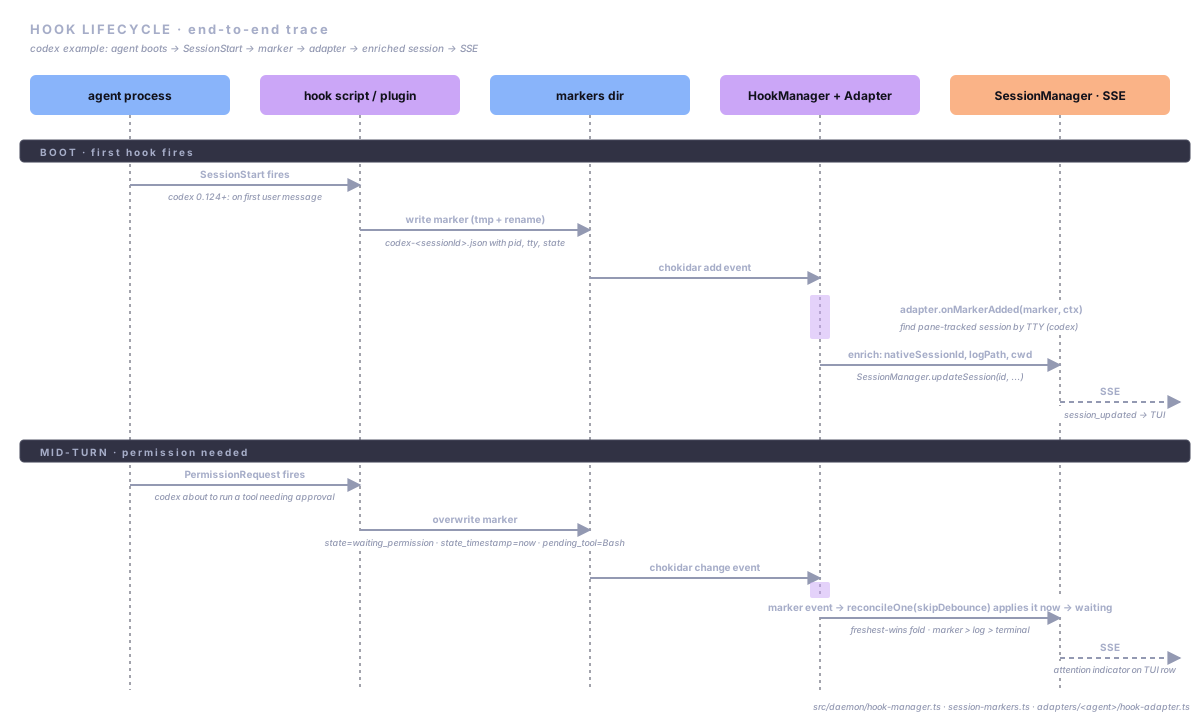
Without hooks, ccmux is best-effort: it scans pane content and guesses. With hooks installed via ccmux setup, agents emit authoritative lifecycle events that map to a stable session UUID, turning each agent from “seen” into “tracked.”
Marker file shape
The entire interface between ccmux and the agent is one JSON file per session, written via tmp+rename so the daemon’s chokidar watcher only sees finished writes (session-markers.ts):
{ agent_type: string, pid: number, tty?: string, // Omitted for OpenCode/Cursor (PID-ancestry pane correlation) session_id: string, transcript_path?: string, timestamp: number, state?: "idle" | "working" | "waiting_permission", state_timestamp?: number, // Fresher than `timestamp` if set pending_tool?: string, // From PermissionRequest hook (Codex/Cursor), tool_approval_requested (omp) permission_context?: string, directory?: string, // OpenCode only title?: string, // OpenCode only last_prompt?: string // Cursor / OpenCode}Per-agent strategies
| Agent | Mechanism | Pane correlation |
|---|---|---|
| Claude | 3 shell scripts (SessionStart, SessionEnd, Notification) registered in ~/.claude/settings.json. |
TTY match (marker.tty to pane.tty) |
| Codex | 3 shell scripts (SessionStart, Stop, PermissionRequest) in ~/.codex/hooks.json, plus the codex hooks feature flag in config.toml ([features] codex_hooks = true pre-0.124, [features] hooks = true on 0.124+; ccmux recognizes either). |
TTY match |
| Cursor | 4 shell scripts (sessionStart, sessionEnd, beforeSubmitPrompt, stop) via ~/.cursor/hooks.json. Scripts walk PID ancestry to find the real cursor-agent PID (Cursor invokes hooks via /bin/zsh -c, so $PPID is a transient shell). |
PID-ancestry: ctx.getPaneHostingPid(marker.pid) |
| OpenCode | One JS plugin at ~/.config/opencode/plugin/ccmux.js subscribed to OpenCode’s message bus (no shell hooks; pure node:fs/promises so the same file runs on Bun or Node). |
PID-ancestry; one server hosts N sessions |
| Pi | One JS extension at ~/.pi/agent/extensions/ccmux.js subscribed to Pi’s lifecycle events (no shell hooks; pure node:fs/promises, auto-discovered and loaded via jiti). Writes the marker at session_start, which fires at launch with full identity (pid, session id, transcript path, cwd). |
PID-ancestry; one session per process |
| omp | One JS extension at ~/.omp/agent/extensions/ccmux.js subscribed to omp’s lifecycle events (oh-my-pi is a hard fork of Pi and kept its extension API, so the file is a near-copy of Pi’s). Adds approval tracking: tool_approval_requested/resolved drive waiting_permission, which Pi has no equivalent for. |
PID-ancestry; one session per process |
| Antigravity | 2 shell scripts (PreInvocation, Stop) via global ~/.gemini/config/hooks.json. The first PreInvocation creates the marker because Antigravity exposes no session-start hook. |
TTY match with PID-ancestry fallback |
Lifecycle (hook-manager.ts)
ccmux setuprunsadapter.install(). Idempotent: writes scripts and edits agent config.- Agent fires hook, script writes marker file.
HookManager.start()first replays existing on-disk markers (covers “daemon was down when agent booted”), then opens chokidar withignoreInitial: true.- Add event triggers
adapter.onMarkerAdded(marker, ctx). The adapter locates the matching pane-tracked session, setsnativeSessionId,logPath,cwd, and (Claude) starts log-tailing. A marker written before the daemon’s first scan created the pane-tracked session would otherwise be orphaned; the shared, agent-agnosticreconcileSessionMarkerLinks()(adapters/link.ts, keyed offadapter.agentType) closes that race on the next scan and re-derives native-id ownership each scan so a mis-linked id heals. - Per-turn signals (Claude
Notification, CodexPermissionRequest, CursorbeforeSubmitPrompt, OpenCodepermission.asked, Piagent_start/agent_end, ompagent_start/agent_endplustool_approval_requested/tool_approval_resolved, AntigravityPreInvocation/Stop) update the marker’sstateandstate_timestamp. The next reconcile tick picks them up via the freshest-wins cascade (evaluateCascade()). - Cleanup:
cleanupStaleMarkers()groups by(agent_type, session_id), dedupes, and applies a 3-level liveness check (PID, TTY, adapter callbackisSessionStillLive); any failed check unlinks the marker.
OpenCode aggregation
OpenCode is the special case. A single OpenCode server process hosts N sessions, so N markers share one PID. aggregateOpenCodeMarkers() (adapters/opencode/aggregate.ts) folds them into one ccmux session with worst-of status (waiting > working > idle). attentionType, pendingTool, cwd, and nativeSessionId follow the newest-waiting or newest-activity marker. Re-folded on every reconcile tick (not just on marker add or remove), so newly-waiting siblings show up promptly. Fold scope is the row’s OWN pane: a marker is folded only when its pid resolves (by process ancestry, paneIdHostingPid) to that row’s pane, since two servers in one directory share OpenCode’s SQLite db and a row can hold a foreign session id until the link pass heals it (issue #177). Symmetrically, the plugin seeds boot markers only for sessions its own status map lists, which is the only per-process evidence that this server hosts them.
Single source of truth for adapters
createBuiltinHookAdapters() in src/daemon/adapters/index.ts is consumed by both the daemon (for runtime registration) and setup.ts (for install / uninstall commands). This prevents the historic footgun where a new adapter got registered for daemon dispatch but not for ccmux setup (or vice versa).
Programmatic invocation (/invoke)
POST /invoke and the ccmux invoke CLI drive a single agent turn programmatically. The path is split behind a registry seam:
InvocationManager(src/daemon/invocation-manager.ts) owns the request lifecycle — concurrency cap, duplicate-id guard, cancel-before-start stash, and per-invocation timeout. It does not know how any specific agent runs. It also keeps a status-only store of active + recently-finished invocations (TTL-purged) and is anEventEmitter(fireschangeat start/finish);GET /invocationsreads the store andccmux invoke listrenders it.InvocationRegistry(src/daemon/invokers/registry.ts) maps anAgentDefto anInvoker. Agents withinvokeModeset go toSubprocessInvoker(Bun.spawnagainstagent.invokeMode.args); the built-inclaudeagent goes toClaudeInvoker(drives the interactive TUI inside a detachedccmux-invoke-<id>tmux session and parses the transcript JSONL).capabilitiesFor(agent, invoker)derivesInvokerCapabilities(requiresHooks,supportsSessionResume) from the invoker kind — the claude-interactive branch returns fixed capabilities, the subprocess branch reads the agent’sinvokeMode— and the server gates pre-flight checks (e.g., Claude’s hooks precheck) through it. Invokers declare no capabilities of their own, soAgentDefstays the only place registering which agent can do what.
This split lets the manager stay generic, lets each invoker focus on one execution mode, and lets the server reject impossible requests (e.g., --session against a non-resumable agent) before the manager spends a slot.
SubprocessInvoker pipes the prompt via stdin, except when invokeMode.args carries a {prompt} placeholder (gemini’s -p {prompt}): then the prompt rides in argv (stdin skipped), capped at MAX_ARGV_PROMPT_BYTES (120 KiB) to avoid a Linux-only execve E2BIG. Full output of subprocess invokes is captured to an ephemeral per-daemon store (invocation-results.ts): each invoke’s stdout/stderr is written to a 0700 mkdtemp dir keyed by id (5 MiB cap), and ccmux invoke result <id> reads it back via the server, reap-tolerant (a gone file is a clean miss; cleanup is delegated to the OS /tmp reaper). Claude invokes drive a tmux session with no stdout buffer, so their result is always a miss in v1.
The board renders these invokes live. The server broadcasts invocation_started / invocation_finished SSE events (via the pure invocationEventToSSE mapping) and embeds an invocations snapshot in the init event for reconnect reconciliation. invocation_started also carries the cwd’s project, isWorktree, mainRepoRoot and worktreeRoot, resolved daemon-side by deriveProjectInfo: a subprocess invoke never becomes a daemon session, so this event is the only chance to give its fabricated row the git-aware project the repo’s real sessions group under, and the resolution walks the filesystem, which must stay out of the TUI process. It is resolved synchronously (a memoized .git walk, never a git spawn) because the invocation stream must stay in strict order with init and session_created — the board’s reconcile and its Claude-invoke de-dup both depend on that ordering. The fields are optional on the wire so a board talking to an older daemon still renders, falling back to the cwd basename. The TUI store synthesizes a paneless row per subprocess invoke (a Claude invoke already appears as its real ccmux-invoke-<id> session, so it is skipped to avoid a duplicate), surfaces a live N invoking count, and routes kill / restart on such a row through POST /invoke/:id/cancel (a one-shot worker has no real session to kill). kill-all is reaped daemon-side instead: handleKillAllSessions cancels every in-flight invocation from InvocationManager.listInvocations() (the authoritative set), since the client’s in-flight set is a lossy mirror that never hydrates invokes a mid-run-opened TUI did not see start. Synthetic rows carry tmuxPane: null, so the picker’s pane-touching paths (attach, preview, switch) all guard on a real pane.
Session references (session-ref.ts)
resolveSessionRef(ref, ctx) is how a human or a peer agent names a session without knowing its id. It is pure and synchronous (window and session facts come from the daemon’s own pane cache, so resolving never costs a tmux call), and it returns resolved (with tier, exact, proximity), ambiguous (with every candidate of the matched tier), or not-found.
Six tiers, stopping at the first tier with any match: session id, %pane, session:window.pane, self, then the fuzzy pair of agent type and project/directory name. Tiers 1-2 reproduce DaemonServer.resolveSession exactly, which is why that function is left alone: existing callers keep their behavior and this one extends around them.
The exact tiers claim their syntax. A ref shaped like a pane, a coordinate, or the literal self that matches nothing returns not-found instead of falling through to the fuzzy tiers, so a mistyped pane id reads as “no such pane” rather than silently becoming a project search that lands on an unrelated session.
Proximity narrows the scope a fuzzy ref is searched in (same window > same tmux session > global) and never picks between candidates: the nearest scope holding any match decides, a unique match there wins even when farther matches exist, and more than one there is a refusal. This is the binder’s prime directive applied to a second surface, ambiguity refuses, never guesses, so there is no recency tie-break and deliberately no --first-style override. The refusal carries every match of the tier (not just the refusing scope’s), sorted nearest-first, because the farther ones are legitimate next commands and the listing IS the recovery path.
Callers pass the caller’s $TMUX_PANE as callerPane (GET /transcript as a query param, POST /handoff in the body). Absent, every fuzzy search runs at global scope, which is the correct answer for a caller outside tmux.
Reading a session’s last response (/transcript)
GET /sessions/:ref/transcript?turns=N answers with the last N completed turns of a session’s conversation, read from the agent’s own transcript. ccmux last is the CLI over it; POST /handoff and the TUI’s “Copy last response” are its other two consumers.
The read is split the same way the invoke path is: transcript-read.ts holds the primitives (a backwards line walk, the JSONL turn fold, the size guards) and transcript-readers/ holds one file per agent plus a registry. Adding an agent is a new file and one entry; nothing in the endpoint changes. A reader returning null (no path, unreadable file, no completed turn yet) means “fall back to the pane” to its caller.
Backwards line walk, not a fixed byte window. A single Claude JSONL line can be hundreds of KB (a 665K-char tool result exists in a real transcript), which defeats every fixed window the codebase already has: readTranscriptTail returns "" when its window holds no newline. Walking backwards line by line lets an oversized line be skipped unparsed while the walk continues, and lets the fold stop as soon as it has the turns it was asked for. The walk is byte-level and joins bytes across chunk boundaries before decoding, since slicing a file at an arbitrary offset can split a multi-byte UTF-8 character.
Where the transcript lives differs per agent: most readers take session.logPath (from the marker’s transcript_path, or from log discovery), OpenCode queries its SQLite database by native session id, and Gemini locates its chat file from the session’s cwd because it has no hooks and therefore no marker. Consequence worth knowing: a session ccmux tracks but whose transcript it has not located (a pane-tracked agent with no marker, say) reads as “nothing to read” and degrades to a pane capture.
Turn shape is pinned so every reader matches: turns=N yields N assistant entries plus only the prompts BETWEEN them, never a leading prompt. turns=1 is exactly one assistant entry (the same shape as the pane fallback, which keeps ccmux last | pbcopy clean), turns=2 is [assistant, user, assistant], i.e. 2N-1 entries; a transcript that runs out early produces the same shape with fewer entries.
Guards: 20 turns per request (clamped daemon-side), 20,000 chars per turn with tail-preserving truncation (a response’s conclusion is at its end), and transcript lines over 256 KiB skipped unparsed: in every sampled transcript a line that size is a tool result, and tool inputs/outputs are never part of a transcript response. Any of them dropping content sets truncated: true.
The response’s optional resolution field carries how the :ref was read (tier, exact, proximity). It is what the CLI’s stderr echo renders, and what POST /handoff reports for both of its ends. capturePane returns "" on any failure, so an empty capture is a 400 rather than an empty success.
Handing off (/handoff)
POST /handoff reads one session’s last response and gives it to another session, or to a session spawned for it. It is composed server-side deliberately: the payload never transits the caller’s context, so an orchestrating agent can move a peer’s long answer to another peer for the cost of one command, and the provenance header can be trusted to describe the session it names. The pure parts (header formatting, compose-with-cap, the queue) live in handoff.ts; the guard stack and delivery live in server.ts, which owns the tmux side. Full user-facing behavior is in docs/handoff.md.
The whole safety case is one rule: a handoff is only ever typed into an IDLE composer. Typing text + Enter into an idle composer is verified for all nine built-ins (it is the notification-reply path); what mid-turn typed input does is verified for none of them, Claude included. So idle delivers, working enqueues, and waiting refuses outright (answering a permission dialog with a pasted peer response is not a thing anyone asked for). There is no --force.
Refusals over degradation. A source with no readable transcript is refused rather than falling back to a pane capture: a screen scrape is fine to READ (GET /transcript falls back to one) and useless as a PROMPT. An ambiguous ref at either end is refused with the candidate list, the to end especially, because delivering a prompt into the wrong session is the worst thing this endpoint can do.
The guard stack is borrowed from notification-action.ts via the shared send-guards.ts module, and it splits across two moments. Sanitizing happens at COMPOSE time, before the request is routed by target status, and it happens twice on purpose: once over the transcript payload as it is read, and again over the final composed text, because a caller-supplied note is only whitespace-folded (\x1b is not \s) and a POSIX cwd may legally contain control bytes, so either can carry an ESC into the header, and a literal ESC inside a bracketed paste can emit its ESC[201~ terminator early and leak the remainder into the pane as live keystrokes. The target checks happen at DELIVERY time (deliverHandoff), in order: ambiguousWait and no-pane first (both disqualify the target outright, so queueing would only defer the same refusal by up to half an hour), then the status gate, then foreground liveness, fail-closed (the reconciler keeps a dead agent’s session idle with its pane still bound, so a handoff pasted after the agent exited would run a peer’s prose as shell commands), then the per-agent unsafeReplyPattern check and the leading //! defuse. Delivery never strips, and does not need to: what it holds is already-sanitized text. The unsafeReplyPattern check is the one target check that ALSO runs at enqueue (queueHandoff), because both of its inputs are frozen by then (the composed text, and the target agent’s own pattern): a payload that agent can never receive is knowable while the sender is still listening, and queueing it instead told the sender “queued” and dropped the record half an hour later with nobody left to report it to. The cwd is backticked in the header for this check’s sake: Cursor’s pattern is /(^|\s)\/\S/, which a bare absolute path after a space matches, so an unquoted cwd made ccmux’s own header refuse every handoff into a cursor target.
The queue (HandoffQueue) is modeled on invocation-manager.ts’s record store: a plain Map, purge on access, plus an .unref()’d sweep timer so it can never keep the daemon alive on its own. At most one pending handoff per target, TTL 30 minutes; a second enqueue replaces the first and reports it, because a queue of prompts would arrive as a burst of pastes the moment the target went idle, which is the exact behavior the idle-only rule exists to avoid. Delivery fires on any transition into idle rather than working -> idle specifically (a target can pass through waiting on its way out of a turn), takes the record synchronously before delivering (so two overlapping idle observations cannot paste it twice), and re-runs every delivery-time check, because a record can be half an hour old and every target fact those checks read can have moved. The text itself cannot move, which is the point of storing it composed and stripped: the dequeue path re-derives nothing and re-sanitizes nothing. A failure at dequeue splits two ways, because the sender was already told it was queued and is no longer listening. A DETERMINISTIC refusal (unsafe-payload, not-at-agent, target-waiting, ambiguous-wait, no-pane) drops the record and logs why, since re-running a check that just said no would only say no again. A TRANSIENT one (the tmux send failed, or the target turned over between the readiness check and the paste) calls requeue with the attempt counted, for the next idle transition to retry, bounded by MAX_HANDOFF_ATTEMPTS (3). A requeue keeps the record’s original expiresAt, so retries cannot extend the TTL, and it refuses to overwrite a newer handoff that arrived while this one was out being delivered. The queue is in memory only: a daemon restart drops every queued handoff, including ones whose senders were told “queued”. The enqueue path also calls the delivery once itself, because the target may have gone idle between the status read and the enqueue, in which case its transition already fired and nothing else is coming.
A pending handoff rides the wire as an optional pendingHandoff: {fromSessionId, queuedAt} on EnrichedSession (enrich-time only, read from the queue, never persisted), and the daemon re-broadcasts the row when one is queued, delivered or expires. The payload is deliberately not on the wire: it is a prompt for the target agent, not content for a session list.
--spawn rides POST /spawn rather than re-deriving any of it, defaulting the agent and cwd to the source’s. A multiline prompt survives spawn’s send-keys-without--l layer intact (verified live for claude and codex): the prompt is always inside single quotes, so every embedded newline arrives while the shell is mid-string and reads as a continuation, and the raw bytes land in argv unchanged. A codex spawn returns a note rather than an auto-answer, because codex holds its initial prompt behind a first-run directory-trust question and the new pane looks stalled until someone answers it.
MAX_SEND_PASTE_CHARS (65,536) is applied to the final composed text, header included, since it is a transport budget for what gets pasted rather than a budget for what was read. The spawn path budgets the same text a SECOND time and in a different unit: composeHandoff caps UTF-16 CHARS while a spawn prompt is bounded in BYTES by MAX_SPAWN_PROMPT_BYTES (120,832), so a CJK- or emoji-heavy payload can sit under the char cap and still overrun the argv budget. handoffToNewSession therefore pre-checks the byte length and refuses with too-large in handoff’s own terms, naming --turns as the retry: forwarded instead, it comes back as a 400 about an invalid prompt field, which is not a field this caller ever sent.
PR enrichment
pr-resolver.ts maps an agent-agnostic (cwd, branch) to its open PR via gh pr list --head. Owned by the Server (like gitInfoCache). Reads are synchronous against a split-TTL cache (stale-while-revalidate; default branches skipped):
- Successful lookups expire after 2 min, so merges clear and new PRs appear quickly.
- Failed lookups (null) hold for 10 min as backoff — their causes (no GitHub remote, logged-out
gh, deleted cwd) persist on the minutes scale.
Refreshes run in the background; a changed value re-broadcasts the affected sessions via session_updated. Because refreshes are demand-driven, the Server also sweeps every visible session’s (cwd, branch) key every 2 min so a fully idle row can’t serve a stale PR indefinitely. PRResolver’s own concurrency cap (MAX_CONCURRENT_REFRESHES, 4) means a cold sweep can only start refreshes for a handful of keys per pass; sweepBranchPRs rotates its starting position through the visible-session list by one session per sweep (sweepOffset) so every key gets a guaranteed refresh attempt within len sweeps, len being the number of visible sessions, rather than the same leading handful winning the cap’s slots every time. Worst-case staleness is therefore TTL + len × sweep interval in the degenerate all-cold-cache case, though in practice the cap clears a cold cache in a small handful of sweeps. The sweep reads the branch out of gitInfoCache (falling back to the log-derived one) rather than re-enriching, so it never spawns git — its whole job is to touch PR keys. That is also an accepted trade: an idle session’s branch label no longer self-heals off a git checkout run in its pane, since the sweep never re-derives git. Only an organic event (the pane’s own agent doing something) or a fresh SSE connect re-reads git and picks up the new branch.
Fail-soft: a thrown spawn disables the resolver for the daemon’s lifetime only when a Bun.which("gh") probe confirms the binary is missing; otherwise (e.g. a deleted worktree cwd) the key is negative-cached. A non-zero gh exit (not a repo, no GitHub remote, unauthed) is likewise a per-key negative.
The lookup also fetches reviewDecision and statusCheckRollup, folding the rollup daemon-side via foldChecks (mirrors gh’s PR-status rollup as shown by gh pr view / gh pr status; empty rollup = "none", never "passing") into the reviewDecision / ciStatus fields on each BranchPR that drive the TUI’s PR-cell color. samePRs compares these, so a CI or review flip re-broadcasts the session even when id and href are unchanged. Feeds EnrichedSession.branchPRs; the TUI’s pr field prefers background rows’ authoritative backgroundChildren and falls back to this.
Source lists (GET /prs, GET /issues)
Two endpoints answering the same shape of question about one repo — what is open on GitHub that you could start work on — and read by the Worktrees panel’s PR view and, once it lands, by issue #151’s source picker. pr-list.ts and issue-list.ts are repo-WIDE, which is what makes them modules rather than more call sites on the two branch-scoped listers: pr-resolver.ts enriches one session’s (cwd, branch) cell and worktree-prune.ts asks --state all about one branch, and neither can answer “what is open on this repo”. Both reuse gh-spawn-source.ts’s plumbing wholesale (injectable runner, explicit env, 15s timeout, failure wording), read every row field by field, DROP a row they cannot identify rather than failing the list, strip control characters out of titles at this boundary because a title travels on into a TUI row, the dialog’s note and an agent’s opening prompt, and report a failure as { ok: false, error } and never as an empty list — “this repo has nothing open” and “gh could not answer” are opposite facts, and a repo with issues DISABLED is exactly the case that would otherwise render as a confident zero. Per-repo failures ride inside a 200 so one broken checkout costs its own section and not the whole multi-repo view.
They are deliberately NOT one endpoint with an include= parameter. The panel’s PR view would pay for issue data it drops on the floor; the two want independent failure, since a repo with issues turned off must still answer about its PRs; and refresh=1 stays per source, so refreshing PRs after a merge does not also re-spawn gh issue list. Both take the same repo/cwd scoping through worktreeRepoRoots that GET /worktrees and the prune scan take, because a client draws all of them as one surface and a repo one endpoint can see and another cannot is a section attached to nothing.
The per-repo TTL that makes a Tab rescope free lives here, in repo-answer-cache.ts, with one RepoAnswerCache instance per source (separate, so a refresh of one cannot evict or re-spawn the other). An entry holds the in-flight PROMISE as well as the settled answer, which is what makes it a lock as well as a cache: a result-only cache is written on COMPLETION, so it can only deduplicate calls that start after one finishes, and concurrent misses for one repo — a picker and a sidebar open at once, a Tab rescope, a reopen on a cold entry, the panel’s r — each spawned their own gh. Sharing the promise also removes the write-ordering hazard rather than guarding against it, since two calls for one repo can no longer overlap and land out of order. Four rules in it are load-bearing and were each a bug: the entry is registered BEFORE the first await so a same-tick caller finds it; an in-flight call is joined AHEAD of the refresh check so a refresh joins rather than races; a refresh bypasses a fresh SUCCESS and never a fresh FAILURE (success goes stale on its own, a failure does not, and the 15s failure TTL is what stops key-repeat on r from serial-spawning one doomed gh per press); and an unforeseen rejection DROPS the entry so a repo cannot wedge “in flight” for the daemon’s whole life. GET /issues ships ahead of any client on purpose: a daemon predating an endpoint is the first-run state for every existing user until they restart it, so the endpoint landing a release early is the only thing that shrinks that window.
Worktree pruning
Worktree creation (worktree-create.ts, the counterpart to this module) is what ccmux spawn --worktree and the picker’s worktree destination call to create or open a worktree before an agent starts in it: mechanical name derivation from --worktree’s value or the prompt’s opening words (no model involved, so a name is predictable and reproducible), per-repo locking around git worktree add so concurrent spawns don’t race, and the same worktree.symlinkDirectories / .worktreeinclude file-setup conventions Claude Code applies to its own worktrees.
gh-spawn-source.ts is the --pr / --issue half of that. gh pr view / gh issue view (injectable runner, env passed explicitly so a test can put a stub gh on PATH, and a 15s timeout the older gh call sites don’t need because this one sits in a spawn’s request path) turn a number into a title, a URL and a head ref; for a PR the module also fetches pull/<n>/head, settles the local branch, and writes the tracking config gh pr checkout would (a fork’s branch points at the fork’s clone URL for both remote and pushRemote) plus ccmux’s own branch.<b>.ccmux-base, so the picker’s D branch review diffs against what the PR targets. Nothing here force-updates a ref: a same-named local branch is reused only when BOTH branch.<b>.merge and branch.<b>.remote already say it is this PR (the remote is compared as a REPOSITORY, resolving a remote NAME through remote.<name>.url, so a branch set up as git remote add fork <url>; git checkout -b foo fork/foo is recognized rather than refused), and only through a non-forced git fetch refspec, so divergence is a refusal rather than a discarded commit. The remote half is not redundant: git checkout -b foo origin/foo writes exactly the merge key a PR branch has, so a fork PR whose author names their head foo would otherwise be fast-forwarded onto the fork’s commits and have its remote rewritten to the fork. Two more refusals guard the edges: a PR whose url names a different repository than origin (gh resolves the number through its own repo selection, the fetch is hardcoded to origin, and in a triangular clone that silently checks out the wrong PR), and a head or base ref starting with -, which git would read as an option in the positional slots both occupy. A TRACKING-config write that fails after the worktree exists is reported through setupFailure, not swallowed: remote landing while pushRemote fails leaves a fork’s branch pushing to origin, which is also why the same-repo path UNSETS pushRemote rather than leaving a stale one to override remote on push. The optional ccmux-base key is the exception: a failed write there rides back as a warnings entry on a successful spawn, because preparePRBranch already refuses to fail a spawn over that ref and the write must not contradict the resolve. ccmux OWNS that key on a --pr branch, so no base to record UNSETS it rather than leaving it: on a REUSED branch a value an earlier spawn wrote would otherwise outlive it and silently become what D diffs against. The branch decision itself is CARRIED, not re-derived: preparePRBranch releases the repo lock before createWorktree takes it (withRepoLock is not reentrant), so createWorktree’s branchExists is the answer that passed the reuse checks above, and a branch that appears or vanishes inside that window is refused. The create re-measures under its own lock only to REFUSE on disagreement, because git alone would not: its remote-branch DWIM recreates a vanished branch from <remote>/<branch> and checks out history that never proved it was this PR.
Three ordering rules in handleSpawn are load-bearing. The lookup runs BEFORE the agent command is built, because the seeded prompt is part of that command. The fetch and the branch decision run under withRepoLock and RELEASE it before createWorktree takes the same lock, which is not reentrant. And the seeded prompt is deliberately NOT threaded into createWorktree: resolveWorktreeName prefers a prompt over a derived name, so passing one would rename the worktree after the PR’s title and lose the pr-<n>- prefix that keeps it clear of the pr-<n> directories Claude Code creates for its own fetch-only PR checkouts. The branch is decoupled from the directory name by createWorktree’s optional branch, which exists for exactly this caller.
worktree-move-changes.ts sits on top of creation rather than beside it. POST /spawn with worktree.withChanges routes the whole destination through moveChangesToWorktree, injecting createWorktree as its CreateWorktree seam (curried with the repo root and the name-deriving prompt, with an ok: false result converted to a throw so the module classifies it as create-failed and unwinds). The worktree is therefore created exactly once, inside the move’s ordering — stash, create, apply, drop — and the pane is only opened after the move reports success.
The move also decides the base rather than letting the engine default it. resolveBase answers an absent base with the MAIN checkout’s current branch, which is right for an ordinary spawn and wrong here: the source is routinely a linked worktree on a feature branch, and an edit to a file both histories have applies cleanly onto main, so the work silently lands on a history missing the commits it was written against. runMove therefore resolves the SOURCE’s rev-parse HEAD before the push and passes that through the seam. A sha, never --abbrev-ref, which answers the literal string “HEAD” for a detached source and would be re-resolved against the main checkout. An explicit base still wins, and an unborn HEAD falls back to the engine’s default.
The seam carries created as well as the path, and a worktree the engine merely OPENED is refused: the rollback force-removes the worktree, so it must never be handed one it did not make. The spawn handler prechecks an explicit name against the repo’s registered worktrees before anything is stashed, so the ordinary case is a 400 with nothing touched; the module’s own refusal covers the race the precheck can lose.
The hosting repo’s .git/info/exclude gets a **/.claude/worktrees/ line (ensureWorktreesExcluded, idempotent because git check-ignore — not a scan for our text — decides whether to write). Without it the first worktree makes the repo permanently “dirty”: the picker’s gate offers a move for a checkout whose only change is other agents’ checkouts, the counts include them, and --untracked copy recursively duplicates every sibling worktree into the new one, since git reports a nested checkout as a directory even under -uall. The spawn handler calls it before either branch rather than relying on the engine’s own call, because a move reads the source’s status BEFORE it creates anything.
The whole transaction runs under a per-repository lock keyed on the shared admin directory (rev-parse --git-common-dir), because every linked worktree of a repo pushes onto ONE stash stack. It is a separate lock map from worktree-create.ts’s withRepoLock, which this one is held across.
A failed move is a 400 carrying reason, and stashSha when an entry was left holding the user’s work. No pane is created. The source has usually been put back, but not always: sourceRestored: false means the restore itself failed (the checkout changed underneath the move), and the stash-confirmation failures return before there is a sha to report at all — in both cases the entry is the user’s only copy, which is why the response says which situation they are in rather than assuming. A failure AFTER a successful move (tmux) is a 500 whose body still carries move, since by then the changes are already in the new worktree.
The ordering, and why there is no git reset of the source, is documented at the top of the module.
worktree-prune.ts answers “which of this repo’s worktrees are finished” and, separately, performs the removal. The split is load-bearing: scanRepos only reads, and its output is the only input runPrune accepts. Note where the guarantee actually lives — runPrune trusts the candidate objects it is handed, so the re-scan is enforced by handlePruneWorktrees in server.ts, not by the prune module. A second caller that skipped the endpoint would lose it. POST /worktrees/prune therefore takes paths, re-scans in-process, and rejects (409) any path the fresh scan does not currently classify as removable — a stale client list, a replayed request, or a hand-written POST cannot delete a directory that has since become active.
Two more fields on that request are load-bearing rather than decoration. cwd must be the SAME directory the candidate list was fetched with, because the re-scan runs over the same discovery the listing ran over (below): omit it and the re-derivation sees a smaller set of repos than the client was offered, so a selection reachable only through the caller’s own cwd 409s on a worktree the user is looking at. callerPane is the caller’s own pane, exempt from the occupancy guard in the run phases below — while ccmux worktree prune runs, its own pane’s foreground command is ccmux itself, so pruning from a pane sitting inside the worktree (the most natural way to do it) would otherwise refuse on this very process. Neither widens what is prunable.
The scan answers in three buckets. candidates are removable, each with a reason; a skipped row is one local evidence called finished but something withheld (see the PR-state rule below); an open row is one withheld because its PR is still OPEN — the healthy in-flight state. That last one is surfaced rather than silently dropped because the Worktrees panel paints a PR badge from it, and an open PR is the single most useful thing a row can say about a worktree. It stays out of candidates for the reason it always did: an open PR means the work is still in flight, whatever the local refs look like.
Repo inventory. Sessions are the inventory the daemon derives for itself: every mainRepoRoot across live sessions, so one session anywhere in a repo (its main checkout included) brings that repo’s whole worktree list into scope and an abandoned worktree with no session of its own is still found. They are no longer the only way in, because a repo whose agents have all exited is exactly the repo whose stale worktrees you want to reclaim. worktreeRepoRoots (server.ts) takes two more inputs, and they are different kinds of thing. An explicit repo is the FILTER, and it is RESOLVED rather than matched against the session roots — resolveMainRepoRoot reads git worktree list’s first entry, so any repo on disk answers, a linked worktree answers with its main checkout, and a bare repo answers with itself (its linked worktrees are the rows the panel exists to show). A directory that is not a repo scans nothing rather than falling back to every repo. A repo whose root IS $HOME is refused, the same carve-out deriveProject and gitProjectName make: a ~/.git dotfiles repo otherwise makes every stray cwd answer “$HOME” and one bogus group swallows the lot. The caller’s cwd is ADDITIVE rather than a filter — it brings the repo the caller is standing in into scope alongside the session-derived ones, de-duplicated against them by realpath so two spellings of one repo don’t each take a turn through the fetch TTL — and a cwd outside a repo silently contributes nothing. Widening discovery is not a widening of what can be deleted: it decides only which worktrees get CLASSIFIED, and what bounds the destructive endpoint is the classification gate, never the repo list.
Reason precedence (strongest evidence first, worktree-git.ts supplying each check):
pr-merged—gh pr list --state allsays merged. The only signal that survives squash and rebase merges, and the only one that justifies a forced branch delete.merged-locally—merge-base --is-ancestoragainst the default branch, excluding a branch whose tip equals the base’s own tip: ancestry alone can’t tell a merged branch from a brand new worktree that never diverged, and the same exclusion deliberately also suppresses a branch that was fast-forward merged and left in place (pr-mergedandupstream-gonestill catch that case). Locally provable, sogit branch -dsuffices.upstream-gone—%(upstream:track)reports[gone]after the per-repogit fetch --prune. The shape auto-delete-on-merge leaves, but not proof of a merge, so it also uses the safe-dand reports a refusal rather than forcing.pr-closed— closed without merging. The worktree is finished; the branch is kept.
Proving a PR is about this branch (selectPRForBranch). gh pr list --head <branch> matches the branch NAME across the whole network — it has no syntax for qualifying an owner, so "<owner>:<branch>" is explicitly unsupported — and the reply mixes in every fork’s PR and every earlier reuse of that name. On cli/cli, --head patch-1 returns 25 PRs from 25 different forks, three of them MERGED. Two asymmetric rules, because the directions have opposite costs:
- OPEN wins over everything, from any repo, with no identity check. An open PR is the state that makes a worktree NOT removable, so a false positive only skips a cleanup while a false negative deletes live work. This is also why it is resolved before merged and closed: a branch carrying both a merged PR and a live one is being worked on.
- MERGED and CLOSED justify removal, so they must be proven, and the proof is one thing: a head SHA equal to the local branch tip. The SHA is what defeats name reuse (a new
feat/xsharing a name with a long-mergedfeat/xhas a different tip) and the fork noise above. A same-repository check is deliberately NOT layered on top:headRefOidequal to the local tip IS the identity, whichever repository the PR was opened from, and requiring the same repo would break the ordinary fork-to-upstream workflow, where every one of your own PRs is cross-repository. An unresolvable tip fails closed.
An open PR (checked against the existing PRResolver cache first, so the common case costs no gh call), a user lock, a detached HEAD, the main checkout, and a PR state that could not be established all mean “not a candidate”. So does a session bound to the worktree that is working, waiting, or background (the synthetic subagent entries included): those never become candidates under any opt-in. An all-idle worktree is the one exception, and only on the strongest evidence there is: the SHA-proven pr-merged. merged-locally, upstream-gone, pr-closed, and no PR at all keep the skip, as does a failed lookup, because a gh-verified MERGED is precisely what dissolves the ambiguity the wide gate existed for. A worktree just branched from base has the base’s own tip, which every local check reads as already merged, so absent a merged PR a live session, however idle, is still what tells a fresh worktree from a finished one. The idle path spends a gh call only when the open-PR cache has no hit, so a repo whose PRs are cached costs nothing extra.
Removing one of those ends the agent, so it needs consent the scan cannot give: allowEndIdlePaths rides next to allowDirtyPaths on the request, and the two are independent axes refused separately (a dirty worktree an idle agent occupies needs both). Both are enforced in runPrune, the destructive core, so every surface inherits the gate. Neither is trusted as an assertion ABOUT the worktree: the endpoint re-derives the classification itself per request, so an opt-in only ever applies to a path this scan independently found removable. Dirty (uncommitted or untracked) worktrees are candidates but are flagged, never pre-selected, and refused unless their path appears in allowDirtyPaths. Consent is not a substitute for freshness, and the live check is a SEPARATE gate rather than a re-read of the opt-in. With the end-idle consent satisfied, runPrune re-reads each session through a liveSession seam and refuses a candidate whose agent is no longer idle even though its path IS in allowEndIdlePaths (its agent is working now, not idle; nothing was deleted). It runs BEFORE the dryRun branch, so a dry run refuses what a real run would refuse instead of printing a removal that could not happen. The seam answers with the session’s PID, PANE and CWD as well as its status, and the pid and pane it returns are the ones the removal signals and closes — the reconciler rewrites a row’s pid when a new process takes over its pane, and a marker claim moves a row between panes, so reading the status from the live row and the pid from the scan could authorize one process and SIGTERM another, the mismatch handleKillSession avoids for the same reason. The cwd carries that one step further: a row can leave the worktree entirely (resuming a session from a sibling checkout re-points its id at a new pane, pid and cwd), and signalling an idle row that has moved would kill an agent in a worktree the run is not touching. A row whose cwd is no longer inside candidate.path — containment, not equality, so an agent that cd’d into a subdirectory still counts as present — is treated exactly like a missing one and logged as a session moved step. An undefined answer is the good case, a session the daemon no longer has: the run proceeds, but with nothing left to signal and without closing the scan pane — handleKillSession 404s a missing row the same way, and the pane can already hold a replacement occupant that occupancy would otherwise exempt as one this run closed. Background sessions are excluded from the whole seam, since stopSessions never signals one.
An unknowable PR state withholds the worktree. gh missing, logged out, rate-limited, offline, or replying with something that is not the requested JSON used to collapse to the same null as “this branch has no PR”, which is precisely how an open PR goes undetected on a branch that looks merged locally. ghPRStateLookup returns a discriminated result instead, and a failed lookup can never reach the reason precedence, so it can only ever withhold a candidate, never manufacture pr-merged. The worktree is reported as a skip naming the error, but only when local evidence (merged-locally or upstream-gone) would otherwise have offered it: a worktree nothing local proves finished stays silent, so a machine without gh does not turn every in-flight worktree into a skip line. The one provable exception is a repo with no remote URLs at all (classifyRemoteHosting, read at full config scope so a remote defined in global or system config counts), where a pull request has nowhere to live and gh refusing to run IS the answer. A remote whose host is not recognizably github.com is treated exactly like a github.com one: a GitHub Enterprise domain, an ssh config alias, and an insteadOf shorthand all host pull requests, and the branch that deletes directories does not get to guess. The classification is repo-level, so it is resolved at most once per scan rather than per worktree.
A setup symlink is not dirt. A node_modules/ gitignore pattern is directory-only, so it does not match a symlink of that name and git reports ?? node_modules. Every worktree set up through worktree.symlinkDirectories therefore read as dirty, which demanded the uncommitted-work opt-in for a link the tooling itself created. readDirtyState skips an untracked entry only when the repo’s merged Claude settings name it AND it really is a symlink on disk (lstat, never stat, whose isSymbolicLink() is false for everything). Exempting it is safe for a structural reason rather than a tested one: deleting a symlink never touches its target, so the worst an exemption can cost is the link, which the tooling recreates.
Ignored files are shown, not gated. Plain git status --porcelain hides them, so a worktree whose only uncommitted content is a gitignored .env reported perfectly clean and could be swept up by “select all” — and since the trash is deleted at the end of the same run, an unbackupable file would go with no recovery window. readDirtyState uses --ignored=matching and keeps the individual ignored FILES, surfaced on the row, at both confirmation steps, and in the run log before the directory moves. Ignored DIRECTORIES collapse to one entry each (!! notes/, and C-quoted as !! "notes dir/" for any path with a space or a non-ASCII byte, where the slash lands inside the quotes) and are kept in their own list, surfaced in the run log only: most are regenerable build output, so putting node_modules/ in front of every confirmation would be the noise the whole policy avoids, but a gitignored notes/ is not regenerable and used to go with no record anywhere. The two kinds get a log line each (deleting ignored: 1 ignored file (.env) then deleting ignored: 2 ignored dirs (notes/, data/)) rather than one joined line, because a step renders on a single un-wrapped row and a joined line loses its tail — the directory half — at sidebar width. Neither list joins the dirty gate: a stray .DS_Store is an ignored file, and a gate that fires on every worktree trains people to clear it reflexively, which is worse than no gate for the case it exists to catch.
Run phases, in this order for a reason:
- Stop each session’s agent and verify it is gone: SIGTERM, wait, and if the process still answers escalate to SIGKILL and verify again. Nothing is signalled that the
liveSessiongate above has not just confirmed still idle, and the pid signalled is the one that gate returned rather than the one the scan recorded, so an agent that picked up work between the list and the confirmation is refused rather than killed and a row whose process changed in that window is not signalled at a stale pid. A candidate whose agent survives even SIGKILL is refused with nothing deleted, since the directory would otherwise be renamed out from under a process still writing into it, which then keeps writing into the trash right up until it is removed. Only then is the pane closed (akill-panethat finds nothing is success: stopping the agent usually takes its pane with it). The panes that close successfully are the exemption list the occupancy guard below runs with, and akill-panethat FAILED is deliberately not among them — exempting it would wave through the one pane already known to be live. Pane liveness is membership inlist-panes, never the exit code ofdisplay-message -t <id>, which is ZERO with empty output for a pane that no longer exists. - Re-check dirty state, after the shutdown wait rather than before it, and as late in the run as a
git statuscan go. The scan’s answer can be tens of seconds old by now (agh pr listper worktree plus the exit wait above), and running the check first left that whole window unguarded: an agent flushing state during its own shutdown, or a user editing in a shell, would dirty the directory in the gap. A worktree that became dirty is refused with nothing deleted unless its path carries the explicit dirty opt-in. - Ask tmux who is actually in the directory (
paneOccupants) — the last check before the rename, and the only one that does not read the daemon’s own session tracking. Everything above descends from a snapshot the scan took seconds ago, and binding a newly started agent costs a pane scan plus a marker on top of that, so an agent that started here during the window is invisible to all of it; tmux, asked at the moment of deletion, has no such latency. A pane counts as an occupant when its cwd is inside the worktree AND its foreground command is not a bare shell AND it is not a ccmux surface. The shell exemption is the whole subtlety: a shell left sitting in a directory that is about to disappear is the ORDINARY leftover, and the prune surfaces are themselves usually opened from a pane in the repo, so refusing on it would block most legitimate removals. An editor is not exempt —isShellCommandis deliberately narrower thanisNonAgentCommandfor exactly this call. A ccmux surface is exempt BY IDENTITY (isCcmuxPaneover#{pane_title}, which every surface sets) rather than by being the caller: a sidebar reportsbunas its foreground command so the shell exemption never covered it, andcallerPanecannot cover it either, sinceTMUX_PANEis unset inside adisplay-popupand the popup picker therefore sends no exemption at all. The exemption list carries the caller’s pane plus the panes this run actually closed — not a scan pane whose live row is gone, which this guard must still see — a pane tmux has not finished reaping must not become a refusal of the removal that just closed it, which is also why the guard sits after the shutdown wait rather than before it. A failure to list panes is fail SOFT, logged as alive-pane check skippedstep, and this is the one place the module does not followreadDirtyState’s refuse-what-you-cannot-inspect rule: an unreadable worktree is a fact about that directory, while an unreachable tmux is environmental, and refusing on it would turn “tmux is missing” into “ccmux can no longer delete anything”. The guard narrows the race; it does not close it (work outside tmux, and a process whose pane cwd is elsewhere, stay invisible). - Rename the directory to a dot-prefixed trash sibling in the same parent — atomic, cross-device-proof, frees the path even while a shell holds it as cwd.
- Clear stale
lockedmarkers (an interruptedworktree addleaves entriesgit worktree prunerefuses to touch) and rungit worktree prune. - Delete branches. After the prune, not before: until the admin entry is gone git still considers the branch checked out in a worktree and refuses to delete it with or without
-D. - Drop the removed paths (and everything nested under them) from each agent state file, backing the file up first.
- Delete the trash directories, so their contents survive for the whole run.
State cleanup (agent-state.ts) treats a state file as “a JSON object whose projects key maps absolute directory paths to opaque state”. Claude Code’s ~/.claude.json is the only one wired up; adding another agent is one descriptor. --state additionally sweeps entries whose directory no longer exists — the backlog from worktrees deleted outside ccmux.
Whole-session search
TUI search unions five sources so a query can match more than the last prompt. Four are instant and client-side (fuzzy over the four identity fields; substring over an in-memory prompt index; substring over the agent’s pane-title summary; substring over captured pane content); the fifth reads live transcripts on demand via the daemon.
-
Summary. The normalized pane-title summary is searched because the
summarycolumn is what a stock layout puts on the row, and text the user can read there has to be findable. It shares ONE score contribution with the prompt rather than adding a sixthMatchSource: they share one cell, and a sixth source would raise the maximum cross-source bonus (50 per extra source) past the smallest tier gap and let corroboration lift a row above a stronger tier. A hit renders ashighlights.summaryin that cell; every other match source keeps the prompt cell’s own evidence, which the summary cell defers to. The rule itself (summaryFromPaneTitle,lib/pane-summary.ts) runs in the DAEMON, which ships the result asEnrichedSession.summary; the TUI searches and renders that field and never re-derives it. -
Prompt index. Each
Sessioncarries apromptsarray (oldest→newest), maintained byappendPrompt(status-machine.ts) and capped by count / per-prompt chars / total bytes (MAX_SESSION_PROMPTS,MAX_PROMPT_CHARS,MAX_PROMPTS_TOTAL_BYTESinconfig.ts). Claude/Codex derive it from the log (replace branch inSessionManager.updateSession); marker-driven agents append fromlastPrompt. It rides the SSESessionpayload, so it is tail-bounded after a daemon restart. -
Transcript search.
GET /search?q=(server.ts→transcript-search.ts) tail-reads each visible Claude/Codex transcript (2 MB cap, 8-way concurrency), extracts user + assistant text (tool calls / results / thinking skipped), and returns windowed snippets. A cheap raw-content pre-filter skips the full parse for non-matching sessions when the query holds no JSON-escaped chars. The TUI fetches it debounced, guarded by a generation counter against out-of-order responses.
Notifications
Desktop notifications are opt-in (notifications.enabled) and edge-triggered on waiting / finished transitions. Notifications are actionable: a permission or plan-approval wait carries Approve / Deny buttons, and permission, plan, question, and finished (idle) notifications carry an inline Reply, all of which reach the agent’s pane without a context switch.
Delivery ladder (notify-delivery.ts wrapping lib/notify.ts). lib/notify.ts is dependency-free (no daemon imports) so the ccmux notify command and the daemon share one delivery path; notify-delivery.ts adds the daemon/session context it deliberately omits. Backend resolution is resolveBackend: an explicit notifications.backend wins, else the auto ladder is ccmux-notifier → osascript on macOS and dbus → notify-send on Linux. Each distinct backend is probed once per daemon run and the result cached (per backend, not globally), so a broken backend logs once and disables only itself. The ccmux-notifier helper binary is resolved once via CCMUX_NOTIFIER_PATH env → ../libexec/ccmux-notifier.app sibling of the ccmux binary (Homebrew layout) → ccmux-notifier on PATH; unresolvable or probe-failed falls through to osascript for that delivery.
POST /notification-action + shared handler (notification-action.ts). The macOS helper is a one-shot CLI app: it posts the notification and exits, and macOS relaunches it on a button press to POST { sessionId, action, statusChangedAt, attentionGeneration, userText? } back. Both that HTTP route and the Linux D-Bus ActionInvoked dispatch funnel into one in-process handleNotificationAction, so the safety rules can’t drift between platforms. An action button types into a live pane, so every mutating action is gated by two orthogonal checks: the action must be whitelisted (default, approve, deny, answer; dismiss is deliberately absent, a dismissed notification posts nothing), the session must still exist, and then (1) both staleness tokens the notification was stamped with, statusChangedAt and attentionGeneration, must still match the session’s, and (2) the pure resolveActionPlan(action, session, agentDef) must find the action legal in the session’s LIVE state and return how to run it. That function is the per-state matrix (approve/deny key maps on permission and plan_approval waits, Reply rows for permission/plan/question/idle); its two safety-critical rows are that every waiting Reply is gated on its cancel prelude being defined (at a numbered picker, un-preluded text + Enter selects the highlighted approve option; a permission Reply is therefore a deny-with-feedback, and the idle Reply alone sends no prelude since Escape at Claude’s idle composer clears a draft), and that plan waits match BEFORE the plain-permission rows (via the shared isPlanApprovalWait predicate) and use the separate planApprove/planDeny keys, keeping Approve on the plain-approve digit (Claude: 2) and never the permission 1, which at the ExitPlanMode picker enables auto mode. Either check failing sends no keystroke, returns 409, and fires a fresh “state changed” re-notification so the user never believes a press landed that didn’t. For a rejected answer the typed reply is never silently discarded (preserveUndeliveredReply): the re-notification quotes the undelivered text back (Tier 1, capped at MAX_NOTIFICATION_REPLY_BODY_CHARS), and when the pane verifiably shows a plain EMPTY agent composer (a fresh capture with no live prompt/picker and a matched empty-composer readyPattern line, foreground still the agent) the text is additionally typed into the composer WITHOUT Enter (Tier 2), and the banner reads “review and press Enter” instead. Prefill is positive-signal only — it never types on the mere absence of a recognized prompt, since several agents’ dialogs act on raw keystrokes — and is suppressed entirely on an ambiguous aggregated row (the shared pane may belong to a different session). approve/deny carry no text, so their re-notification is unchanged. The two tokens cover different edges. statusChangedAt pins a status transition (only status edges bump it, in SessionManager.updateSession) but not an attention flip within waiting. attentionGeneration closes that gap: it is a monotonic per-session counter bumped in the same updateSession whenever the attention identity (attentionType or pendingTool) changes, so a waiting → waiting swap (one wait resolves and a new same-type wait begins, e.g. permission Bash → permission Write, which never leaves waiting) still moves the token and a press stamped against the resolved wait is rejected rather than answered blind. Enforced for approve/deny/answer only (never default), and fail closed: a notification from an older daemon build carries no generation, so its press mismatches and re-notifies instead of acting. One residual window remains: the generation only moves when the daemon observes a FIELD change, so a swap it can’t see as a change bumps nothing and neither token catches it. That covers two shapes: both edges of the swap landing inside a single reconcile scan with no marker events between them (the daemon only ever observes the second state), and a field-identical swap where the intermediate working edge is missed and the new wait carries the same attentionType AND pendingTool as the old one (two consecutive Bash permission prompts fold to indistinguishable states, since pendingTool is the tool name, not the command). The pane-authority gate below is the last line of defense there, and it too passes when the prompts are of the same type; closing that fully would need a per-wait identity in the marker payload itself. A third guard covers aggregating agents (OpenCode): one server folds N server-side sessions into one ccmux row, so a keystroke lands on whichever dialog the shared pane renders — possibly a different server-side session than the notification described, an edge the tokens can’t see (this row’s status and attention identity don’t move when a SIBLING session starts waiting). aggregateOpenCodeMarkers sets Session.ambiguousWait whenever more than one marker is waiting_permission at once, and both the notifier (which withholds the buttons at delivery, shipping an informational-only banner) and handleNotificationAction (which 409s a press that raced into the ambiguous state) refuse to act while it holds. A reply sends its prelude keys plus a settle delay, then the text; text beginning with / or ! gets one leading space so it reaches the agent as a message instead of tripping the slash-command palette or Claude’s shell mode, where it would RUN as a shell command with no permission prompt (verified on 2.1.211). Reply text is sanitized to a single control-char-free line and length-capped (MAX_NOTIFICATION_REPLY_CHARS) before it reaches ccmux send.
Pane authority for the plan/permission split. The stored classification is unreliable in BOTH directions and the staleness token can’t catch it (status stays waiting throughout): a live plan wait USUALLY arrives stored as { permission, pendingTool: null } (the marker reports a null tool and ExitPlanMode’s tool_use is frequently deferred out of the JSONL; see the plan-approval bullet in agent-adapters.md), and a permission wait right after a plan wait can retain a stale ExitPlanMode pendingTool (the cascade evaluator carries the tool name forward). Because the null-pendingTool window is the COMMON case, a veto-style guard would 409 nearly every real plan approval, so the PANE decides instead, at both ends of the flow. At press time: for any approve/deny/answer press on a waiting permission/plan wait by an agent with planApprove defined, the handler captures the pane, classifies it with classifyClaudePromptPane (pane-classify.ts, bottom-anchored on the last prompt terminator so a stale plan footer can’t shadow a fresh prompt below it), and passes the result into resolveActionPlan as the AUTHORITATIVE wait type, driving both the Approve key choice and answer’s prelude. For approve/deny a null classification (or a capture failure) means no active prompt is on screen and the press 409s, fail CLOSED, because keying 1 at a plan picker enables auto mode and 2 at a Bash prompt is the persistent grant; answer alone falls back to the stored wait type on null, since an AskUserQuestion picker classifies as null by design. A reply that cancels a prompt the handler CLASSIFIED then re-captures the pane after the prelude’s settle and requires the prompt to be provably gone before typing, 409ing fail CLOSED if it is still live or the capture fails: the prelude is otherwise fire-and-forget (sendKey resolving true only means tmux accepted the keystroke), and an Escape immediately followed by printable bytes can be read as ONE Alt+char sequence, so the still-live picker swallows the text and the Enter selects the highlighted option, silently APPROVING a deny-with-feedback press (reproduced on 2.1.212; the settle delay makes this rare, not impossible). And before ANY send, a liveness guard checks #{pane_current_command}: the reconciler keeps a dead agent’s session as idle with its pane still bound, so if the foreground process is a shell a Reply would EXECUTE as a command, and the press 409s (also fail CLOSED on a query miss). At notify time: buildNotificationContext runs the SAME classifyClaudePromptPane over the live pane for a Claude permission/plan wait, promoting the delivery to plan_approval (reclassifyAs) when the pane shows the plan picker, so the notification carries the plan actions (Approve = 2), the plan Reply, and the “Plan ready for review” subtitle instead of the permission variant; the isPlanApprovalWait predicate is only the capture-failure fallback, and the offer side fails open (the press-time handler is the enforcement point).
Payload shape (notifier.ts → NotificationPayload). title is the session identity, agent-first over the TUI’s project:branch ref convention (Claude · ccmux:feat/notifications, or Claude · ccmux with no branch). The ref is passed whole, with no pre-truncation: the agent leads, so macOS’s single-line tail-truncation at render can only ever cost the ref’s tail, never the agent name. subtitle is the event line — the describeAttention string for a wait (“Needs permission: Bash”, “Waiting for your input”, …) or “Finished” — and is always set. body is contextual content only (the pending command/question, or a finished turn’s closing words) and may be empty. Backends with a native subtitle slot (ccmux-notifier, osascript) render all three lines; notify-send and D-Bus have no subtitle field, so foldSubtitleIntoBody prepends the event line as body line 1 (skipping empty parts). The stale-press re-notify (buildStateChangedPayload) clears the subtitle, since its body is already a self-contained “state changed” message.
Context bodies (notify-context.ts). So a notification’s body shows what it is waiting on (under the event line the subtitle carries), buildNotificationContext gathers context at notify time. A permission wait captures the live pane and extracts the command block from Claude’s approval prompt (extractPermissionPrompt) — NOT the transcript, because Claude only flushes the permission-gated tool_use entry to its JSONL after the permission resolves, so the transcript is empty for the whole wait; the pane also shows the post-PreToolUse-rewrite command, which is what will actually run. A question wait reads the question straight off the pane picker (extractQuestionPrompt), falling back to the last assistant message from the transcript tail only for a plain-text question with no picker (during Claude’s AskUserQuestion picker the tail still holds the stale prior turn). A plan_approval wait (ExitPlanMode) is transcript-FIRST: buildPlanContext reads the last ExitPlanMode tool_use’s input.plan from the transcript tail (complete and clean) when present, clamped to 4 lines / 300 chars. But that tool_use is frequently deferred out of the JSONL during the wait, so it falls back to extracting the plan box off the pane: extractPlanPrompt anchors on the “Here is Claude’s plan:” header and reads DOWN to the bottom box rule, skipping the box’s blank padding (plan waits take a deeper pane capture, since the plan box sits well above the picker). If the header scrolled off (a very long plan), the body stays null. A finished event instead enriches via buildFinishedContext: Claude’s last assistant text off the transcript tail (safe here — a finished turn IS flushed), then any agent’s lastPrompt, then nothing, clamped tighter (2 lines / 200 chars) than the waiting context (4 / 300). Claude-only for the waiting context in v2 (others return an empty body); all text is agent-derived so it is stripped of control characters (keeping \n, which the helper renders verbatim) and clamped to a few glanceable lines. Fail-open: any parse/read error leaves the body empty and the subtitle carrying the event on its own.
AskUserQuestion disambiguation. Claude fires the Notification hook for its AskUserQuestion option picker with the same permission_prompt payload as a real permission prompt (see agent-adapters.md), so the marker lands as waiting_permission. Because the pane is the only source that tells them apart, the fix lives in two places. Pre-fold source correction (correctAmbiguousPermissionMarker, gated by AgentDef.ambiguousPermissionMarker): when the native cascade’s marker candidate claims a permission wait, the reconciler captures the pane, runs the terminal rules, and if they report a question picker relabels the marker candidate’s attentionType to question before the freshest-wins fold — the fold itself stays a pure freshest-wins evaluator (the marker keeps its status and freshness, only its attention label changes). Delivery-time reclassification: the notifier reuses the single context-build pane capture; when the permission extraction finds no terminator but the pane matches the question-picker signature, buildNotificationContext returns reclassifyAs: "question", and buildPayload renders the Reply variant instead of Approve/Deny for that one delivery — covering the one-scan race before the store correction lands. Store mismatches in that window are caught by the handleNotificationAction staleness gate (409 + re-notify).
Retraction. A delivered notification goes stale two ways, and both fire retract(sessionId) fire-and-forget: ccmux-notifier remove --group ccmux-<id> on macOS, CloseNotification on the live D-Bus connection, a no-op for backends that can’t retract. (1) The user looks at the pane: handleActivePaneNotification (POST /active-pane, which already flips attentionState to read) retracts. (2) The wait itself resolves: the Notifier tracks which sessions have a successfully delivered waiting banner (deliveredWaiting, populated only on actual delivery) and retracts the moment that session leaves waiting — including the waiting → working transition that produces no new notification, so a “Needs permission” banner clears when its prompt is answered even though nothing new fires. It never retracts a session that had no delivered waiting, so an unrelated finished banner in the same notification group is left alone. Both callers share ONE delivery closure, so retraction reuses the deliver path’s probe cache, its resolved helper-binary path (the retract must spawn the exact same ccmux-notifier the deliver path probed, or it would ENOENT while delivery works), and its lazy D-Bus connection (the same connection owns the replacesId map the close targets). A retract failure is logged at debug, never warn: it is best-effort cleanup and a missing helper must not error-spam.
D-Bus action dispatch. Unlike the spawn-based backends there is no shell command built ahead of time; resolveDbusOnAction builds an in-process callback that runs when the signal fires. default / Open jump (bound session → its pane, background/unbound → the picker popup, same routing as performJump); approve / deny / answer call the shared handler directly. Inline reply is gated on the server advertising the inline-reply capability: the freedesktop inline-reply action key only signals the text field opened, so it is a no-op; the typed reply arrives on the separate NotificationReplied signal mapped to answer.
Killing a session (/sessions/:id/kill)
Removal is death-gated, not acknowledgement-gated. handleKillSession snapshots the row’s pid, sends SIGTERM, then polls liveness (waitForExit, signal 0, 100ms, capped at 2s) and removes the session only once the process is confirmed gone. Removal happens daemon-side precisely so every attached client learns about it through the ordinary session_removed broadcast, rather than each one optimistically dropping the row and guessing whether the kill worked (issue #135). A SIGTERM that was already unnecessary (ESRCH) removes the row immediately, with no wait: the row is stale by definition.
The response carries an additive killed: boolean. A process that outlives the cap keeps its row and reports killed: false; the scan loop’s liveness cleanup owns it from there, so a surviving agent is never hidden from the picker. Before removing, the handler re-reads the row and skips a different non-null pid: the pid snapshot fixes which process was waited on, but the row is addressed by id, and a pane-tracked id outlives the process it names (createPaneTrackedSession mutates in place when a new agent appears in that pane).
handleKillAllSessions deliberately does NOT share this path: it is a synchronous SIGTERM sweep with no wait and no removal, so bulk-killed rows still linger until the next scan. Group kill is not the bulk path (the TUI fires per-row /kill requests concurrently), so it does get the death-gated removal.
Background agents (paneless Claude)
A third tracking mode, background, is owned solely by sources/claude-background.ts and is excluded from every reconciler arm (reconcileOne, reconcileAttentionStates, cleanupStaleSessions, matchSessionsToPanes). These rows are Claude Code background agents (claude --bg / the agent view): paneless (PID + cwd + JSONL transcript, no tmux pane), and their worker pid belongs to Claude’s supervisor rather than ccmux, so ccmux never SIGTERMs it.
Stopping a background row. handleKillSession does NOT exclude them: it shells out to the agent’s backgroundStopCommand (claude stop <short> for Claude; agents that don’t define one get a 400), mapping a nonzero exit to a 500 carrying stderr, except when that stderr matches the agent’s backgroundStopAlreadyGone pattern (the worker was already stopped, so the row is on its way out and the stop counts as success). claude stop, not claude rm: stop leaves the conversation resumable via claude attach, which is what x means for every other row. The handler never removes a background row itself, because their removal is event-driven: the supervisor drops the short from roster.json and the source’s watcher reaps it. handleKillAllSessions still skips background rows entirely, so the bulk sweep leaves them running while single-row x and kill-group stop them.
The source watches Claude’s own ~/.claude/daemon/roster.json (authoritative live membership and the SOLE death signal) and each ~/.claude/jobs/<short>/state.json (status — needed because roster mtime does not bump on the active→blocked transition). deriveBackgroundState (background-state.ts) is the pure status fold; the source diffs the roster into the SessionManager. Independent of hooks and pane scanning.
Constructed in Daemon.start() only when backgroundAgents !== false (opt-out config gate; off means no watchers, no rows, no per-scan resync). Interactions: a peek preview, a claude attach launcher, and x to stop the worker (see above).
Which tmux server (the socket override)
Pane ids (%3) are unique only within one tmux server and collide across servers, so ccmux commits to exactly one. Which one is resolved in src/lib/tmux-socket.ts: the --socket/--label flag on ccmux daemon start (exported as CCMUX_TMUX_SOCKET so a backgrounded daemon inherits it), else CCMUX_TMUX_SOCKET itself (leading / means a path, anything else a label), else the tmuxSocket preferences key, else nothing at all. Applying it is per-process: the daemon always honors it (it inherits $TMUX from whatever auto-started it, and deferring to that is issue #95 itself), while a client honors it only when $TMUX is unset, since a client inside tmux is physically attached to that server.
src/lib/tmux-exec.ts is the single argv builder every call site goes through (tmuxArgv, tmuxArgvFor for a caller-resolved binary, tmuxShellPrefix for a nested invocation inside a run-shell body). It prepends -S <path> / -L <label> only when an override applies, so an install with nothing configured produces byte-identical argv to the hand-spelled ["tmux", ...] it replaced — asserted directly in tmux-exec.test.ts. The one deliberate bypass is ccmux sidebar --resize --socket, whose socket comes from a pre-upgrade hook body that already names its own server.
currentTmuxSocket() (tmux-server.ts) reports the override’s resolved path when one applies, which makes the cross-server guard strictly stronger: a client outside tmux used to know nothing about its own server and had to fail open. A label resolves the way tmux does, $TMUX_TMPDIR (else /tmp) plus tmux-<uid>/<label>, realpath’d because #{socket_path} comes back resolved and the guard compares the two literally.
Unreachability is surfaced rather than swallowed: getServerSocketPath() records socketError with the socket it tried, the scan loop’s PaneDiscoveryError names it too, and the picker, the sidebar, and ccmux show render “tmux server unreachable at <path>” in place of an empty session list. Multi-server aggregation stays out of scope; the builder is a step toward it, not a blocker.
Daemon lifecycle and boot ordering
The Server (server.ts) starts at the top of Daemon.start(), before session migration, marker replay, and the initial scan: auto-start callers poll /health on a short budget, and a session-heavy boot would otherwise outlast it. Early SSE clients get a sparse init and hydrate live via session_created / session_updated. GET /server-info returns { socketPath: string | null, socketError: { attemptedSocket, message } | null, health: DaemonHealth } — the tmux socket the daemon scans (so consumers can refuse cross-server pane targeting), why it could not be reached when it could not, plus the current scan-health snapshot (see below). socketError is additive: a daemon predating it omits the key, and clients read a missing field as null. The cached socketPath is dropped on any failed pane scan, so a tmux restarted onto a different socket re-probes instead of leaving every client guard comparing against a dead one.
When a scan throws SCAN_DEGRADED_THRESHOLD (10) times in a row (discovery failure or any other scan error), the daemon flips to a degraded health state — one loud log line, suppression of the per-scan Scan skipped: spam, and a daemon_health SSE broadcast (issue #46). The next successful scan flips it back with a recovered broadcast. The snapshot (ScanHealth.snapshot() → DaemonHealth) also rides the SSE init frame and GET /health, so a client connecting mid-degradation banners it immediately. startDaemon() also does process.chdir("/") before anything else: a daemon launched from a since-deleted directory (e.g. a removed git worktree) would otherwise make every Bun.spawn throw and freeze scanning silently — root is never deleted.
GET /agents lists the agents this machine can start, for the picker’s new-session dialog (issue #65): { agents: [{ name, displayName, shortCode, supportsPrompt }] }. Names are enumerated from the merged config (getAgents) but each is then resolved through the daemon’s OWN agent lookup, the same one POST /spawn uses, and dropped if it isn’t there. The daemon builds its agent list once at boot, so reading the config directly would advertise an agent added to ccmux.json since then and have the spawn answer Unknown agent. Within that set, built-ins are PATH-gated (Bun.which on the launcher POST /spawn would run, so Claude’s command preference counts) while custom agents are listed unconditionally — a hand-declared executable is as likely to be a wrapper which can’t see as it is to be missing. Resolved per request, not cached: it is asked for only when the dialog opens, and a cache would hide an agent installed on PATH since boot.
For ordinary spawns and moves, the dialog sends its placement as callerPane, never target; the in-checkout fork exception is described below. The two differ for a new window: an explicit target inserts one right after that window and renumbers every later window in the session, while callerPane only pins the session and appends at the end. The picker means the latter — and for a split, callerPane still splits exactly that pane. The pane it sends is resolved fresh on every spawn, not cached at mount (resolveLaunchPane in src/tui/utils/tmux.ts): a cached pane goes stale once its neighbour closes, and a tmux list-panes per explicit spawn is not worth caching against. ccmux-titled panes are excluded unconditionally; excluding the surface’s own pane is gated behind an excludeSelf flag that only the sidebar passes, since a sidebar persists and must never target its own rail, while an inline picker vacates its pane on spawn and should target exactly that pane. This is what keeps a sidebar from halving its 30-column rail.
A worktree destination travels as one object: worktree: { name?, base?, withChanges?, untracked? } (normalized by normalizeWorktreeRequest in spawn-command.ts; absent, null or false means the ordinary spawn into cwd). Moving changes lives inside that object rather than beside it, which makes “changes need a worktree to move into” structural — the invalid combination cannot be spelled — so the only pairing left to refuse is untracked without withChanges (400, alongside an untracked outside move/copy/leave). The dialog sends a name only when one was typed into its Name row (issue #83); left untouched, the row previews what the daemon would derive and the request carries no name at all. The distinction is the request, not a formatting detail: a name means create-or-open, so posting the preview as if it had been typed would drop the agent into an existing worktree of that name instead of the numbered sibling a derived name gets. Typed names are slugified client-side with the daemon’s own slugify; one that slugifies to nothing is REFUSED on Enter rather than quietly demoted to “no name”, because with a prompt present the demotion silently spawns under a derived name the user did not type (the field keeps the text either way, so the refusal has something to point at). The CLI’s --with-changes / --untracked enforce the same two rules locally, before ensureDaemon, so a typo cannot start a daemon on the shared port.
The same dialog also posts FORKS (issue #70), which F and the row menu’s one Fork item both open: { fork: <sessionId>, split, detach: true } plus a placement and, for one of the two destinations, a worktree. No agent, cwd or prompt at all — the daemon reads every one of those off the session being forked. The destination is what differs, and it differs in two places at once. Continuing in the source’s OWN checkout sends no worktree key (the object is what asks for one) and takes its split out of the SOURCE’s pane (split: "h", target), which is where a sibling of that conversation belongs; that combination is the dialog’s default, so F Enter is byte for byte the one-shot fork this replaced. Continuing in a worktree sends worktree: {} — present even when empty — and follows the ordinary spawn rule instead (callerPane, no target), because a fork that has left the source’s checkout is no longer that pane’s sibling. Only a typed name goes inside the object, and a fork’s derived name is <branch>-fork cut from the source checkout’s own HEAD rather than a slug of a prompt it does not have. worktree.withChanges on a fork is refused (400) and the picker has no way to spell it: the move empties the checkout its source is still running in. mainRepoRoot is checked client-side, but it gates only the CHOICE — a row outside a repo still forks, with its destination locked to the checkout it is already in.
What the picker does with the ANSWER to a move is App.tsx’s half of the same contract, and the split is between messages that expire and messages that wait. A failed spawn whose body carries stashSha, sourceRestored: false, or a move (a move that landed before a later failure) raises a dismiss-on-any-key dialog (NoticeDialog, store.state.notice) carrying the daemon’s message plus the recovery lines; so does a landed spawn whose move reports a leftoverStash or a flattenedIndex. Everything else is a toast. The picker’s exit into the new pane is interposed rather than skipped in that case — the pane exists, so the handover is delayed until the message has been read, never cancelled. A 200 with no move on a request that asked for one is the stale-daemon signal (an older build drops the keys it does not know and spawns into an empty worktree); it is reported as a failure with the same restart advice ccmux spawn --with-changes gives, since the absent report is the only evidence there is. The wording for all of it lives in src/lib/move-report.ts, shared with the CLI so the two surfaces cannot describe the same operation differently.
POST /sessions/:id/send routes single-line text through sendLiteralToPane and multiline text through sendPromptToPane in pane-io.ts; the latter uses tmux bracketed paste so embedded newlines remain one prompt, and both paths honor requests that paste without pressing Enter.
lifecycle.ts owns process management: PID-file read/write, HTTP /health liveness (used instead of the PID file alone, because a dead daemon’s PID can be recycled by an unrelated process — a false positive would suppress auto-start), detached background spawn, and PID-reuse-safe zombie-port recovery. stopDaemonByPort signals only the confirmed port LISTENer found via findDaemonPidByPort (lsof -sTCP:LISTEN), never the PID-file PID, and spares a foreign squatter whose ps command line isn’t daemon start (fail-open on an unreadable cmd to preserve recovery). The auto-start/recovery flow that composes these lives in src/commands/shared.ts (ensureDaemon → launchDaemon: evict the zombie holding the port, spawn fresh, wait for health, surface the blocker’s PID/cmd on failure), shared by every CLI entrypoint.
Build identity and automatic replacement
The daemon outlives upgrades: after a new version, a bun run build, or a reinstall it keeps running the old code while every CLI command connects to it (issue #163). Each process computes a BuildIdentity (src/lib/build-identity.ts) at MODULE LOAD, before the daemon’s chdir("/") or a command’s chdir to CCMUX_CALLER_PWD can move it off the relative argv[1] that bin/ccmux hands bun: version (package.json), artifact (a compiled binary’s realpath, or for bun <script> the checkout root, so dist/index.js and src/index.ts of one checkout share it while a sibling worktree does not), and stamp (size:mtime of the executed file). The daemon publishes its own on GET /server-info as build, next to busy: { invocations, handoffs } (running invocations plus queued handoffs, after a TTL sweep).
classifyDaemonBuild compares the daemon’s identity with the CLI’s in a fixed order. No identity or a malformed one is outdated (a daemon predating the field is replaced once, even from another checkout). A different version is outdated, whatever the artifact, because a release bump should win everywhere. The same version from a different artifact is foreign, and foreign is deliberately left alone: two worktrees on the same version would otherwise flip-flop the one shared daemon on every command, so switching checkouts stays an explicit ccmux daemon restart. The same artifact with a different stamp is outdated (rebuilt or reinstalled in place). Otherwise current. One outdated verdict is deliberately not acted on: isTransientSourceRun marks a CLI that is executing a checkout’s SOURCE while that checkout also holds a dist/index.js, which is what bin/ccmux produces for one edit (it runs src/index.ts and rebuilds the bundle in the background). Evicting there costs two restarts per edit, source then bundle, so that run defers and the next launch, from the bundle, does the single correct replacement. It is computed at module load like the identity itself, and ccmux daemon restart bypasses it entirely.
reconcileDaemon (commands/shared.ts) is what every auto-start path runs, ensureDaemon directly and the picker as a side-effect-free probeDaemon inside its startup Promise.all followed by settleDaemon. /health on its 100ms budget remains the only thing that decides an UNREACHABLE daemon, with one retry: a probe that TIMES OUT is repeated once on HEALTH_RETRY_TIMEOUT_MS (1s), because a daemon half a second into boot has already bound the port and answers late, and reading that as “not running” makes the caller SIGTERM a healthy listener. A REFUSED connection is never retried, so the no-daemon cold path keeps its single short probe. A live one gets a best-effort /server-info read on a separate DAEMON_INFO_TIMEOUT_MS (1s) budget that fails OPEN: a slow or unreadable answer counts as current, so a live daemon is never evicted on a slow read. An outdated daemon is replaced only when idle, which means busy reports zero invocations and zero handoffs; a daemon too old to report busy is asked GET /invocations instead (a 404 is idle, an unreadable answer is busy, fail safe). An outdated busy daemon is kept, with one stderr line naming the counts and ccmux daemon restart. A deferred one is kept silently (settleDaemon returns deferred), since nothing is wrong and the rebuild is already in flight. Right before the kill the CLI re-reads /server-info once, so a daemon another command already replaced is not killed again. ccmux daemon status prints both identities and the verdict, and says when an outdated verdict is deferred for that reason.
TUI
The picker and sidebar are one @opentui/solid app: src/tui/App.tsx owns key routing and dialogs, src/tui/store.ts holds the reactive state, components live in src/tui/components/. The subsections below are the load-bearing design rules for the three surfaces with real internal machinery; most were arrived at by live testing, so treat them as behavior contracts, not style preferences. The daemon-side contracts they ride on (GET /agents, spawn placement as callerPane, the worktree request object, forks, the move answer) are in Daemon lifecycle and boot ordering.
Row menus
Both row menus open from the pointer (right-click) and from m, through one openRowMenu in App.tsx — so the item lists, and the dirty question below that gates one of them, cannot differ by how the menu was asked for. The two paths differ in exactly two things. The ANCHOR: a click carries its own screen coordinates, while m asks the list where the selected row currently is (SessionList’s onRowAnchor, which is the only place that knows the row heights, the scroll offset and the viewport’s origin at once; it is a pull, since the answer changes with every scroll and resize). And the HIGHLIGHT: contextMenu.highlight is null for a click, because the pointer highlights by hover, and the first item’s id for m, so Enter has a target the moment the menu appears. While a menu is open App.tsx routes j/k, Enter and esc/m to it, plus any item’s own key accelerator (ContextMenuItem.key, menu-local by design: Hand off answers to h, whose meaning on the list itself is collapse-group and so cannot ride the fall-through), and lets every other key dismiss it and mean what it always means.
That highlight is an item ID, not a row number, and the reason is that the list mutates under an open menu: “Move changes” appears when the dirty check answers, and Fork vanishes on an SSE update that drops nativeSessionId. Neither is last in the menu any more (Kill is, because destructive actions belong at the bottom), so an insertion shifts the rows beneath it — and by position the highlight would ride that shift onto a neighbour, with the next Enter running an action nobody chose. By identity it stays on its item, and an item that leaves takes its highlight with it (Enter then does nothing, rather than firing whatever slid into the row). A pointer is different because it aims by screen coordinate: once it enters any item, ContextMenu snapshots the current items and reserved height while the pointer owns the menu, so the action under the pointer cannot change between aiming and mouse-down. If the pointer leaves and keyboard navigation establishes a highlight, the snapshot is dropped and the keyboard resumes against the live list; until the first hover, and throughout a keyboard-only interaction, the menu remains reactive.
GET /sessions/:id/dirty gates the row menu’s “Move changes” item, and the picker names the directory explicitly (?cwd=) rather than relying on the endpoint’s paneCwd ?? cwd default: the client decides the move’s source directory from the row snapshot it holds, the daemon would re-derive it from a pane cache that can be a tick behind, and a gate answering about a different checkout offers an action that then refuses. Because that answer arrives after the menu is drawn, the menu reserves its row up front (ContextMenu’s reservedRows): clamped against the bottom edge a growing menu moves upward, sliding every row out from under the pointer. The reservation is held for the menu’s life, since releasing it on a “clean” answer moves the menu just as surely. It reserves HEIGHT, which keeps the box still. The item itself lands above Restart and Kill, so those two move down while a keyboard-only menu is still reactive; after the pointer first enters an item, the snapshot described above keeps every row fixed instead.
New-session dialog
The new-session dialog (n, or the row menus) is driven by NEW_SESSION_FIELDS in store.ts plus a matching NewSessionDraft key per field. Focus movement, the option keys, the rendered rows, and the dialog’s own height all read that list, so adding a field is additive rather than a rework of the key handling — but it is not a one-liner: expect to touch the field list and draft key, the store action and the dialog’s open-time default, optionFieldFor() in App.tsx, the component’s props and its render branch, and the row budget in NewSessionDialog.tsx (planDialogRows and newSessionFloorRows, below).
Every option field renders as a one-row dropdown pill (DropdownTrigger in DropdownField.tsx) whose list opens as a single shared absolute overlay (DropdownOverlay, a late child of the dialog box for the sibling z-sorting reason DropdownField.tsx’s header explains). What each field offers, and which option it holds, comes from ONE accessor (newSessionOptions in src/tui/new-session-options.ts) shared by the key routing, the pills, the overlay, and the store’s value dispatch. Which dropdown is open, and its highlight, is one record on the draft (dropdown: { field, index } | null), so two can never be open at once; space/l/right open the focused field’s, and while open the overlay owns every key (j/k navigate, enter/space/l/right confirm, h/left/esc cancel, 1-9 direct-pick). The overlay lives OUTSIDE the row budget and clamps against the screen, windowing itself via optionWindow.
Not every field is present every time. The dialog has five modes — an ordinary spawn, “Move changes” (issue #71), “Fork” (issue #70, which drops the agent and prompt rows because a fork continues the source’s), an EXISTING worktree (issue #102, the Worktrees panel’s Enter on a session-less row, which creates nothing and so drops the destination row outright: the row it was opened over IS the destination, and there is no worktree to name), and a worktree cut from a PR (issue #151, the panel’s Enter on an open-PR row, which CREATES one and still names nothing: the daemon derives the name from the PR with slugForPR, and POST /spawn refuses pr alongside worktree.name or worktree.base) — and NewSessionShape in store.ts is the type the two POLICY functions take (namesAWorktree and newSessionFields). Do not read more into that than it gives: a mode added as a NULLABLE field leaves both functions type-valid, which is exactly what the PR mode did, so what they force is a decision at REVIEW time, not at compile time. The compiler’s real catch is a new FIELD, below. A mode is not the same thing as a DESTINATION: a move locks its destination to a worktree and a fork picks one like an ordinary spawn does (locked to the source’s own checkout only where fork.canWorktree is false, i.e. the source is outside a repository), so namesAWorktree reads the destination and the mode flags rather than the mode alone — which is why the Name row, and the row it costs, come and go inside fork mode. The row budget is not protected that way: both budget functions now read ONE named flattened shape (DialogModeShape in NewSessionDialog.tsx, which newSessionFloorRows takes directly and DialogShape extends with the width-dependent counts planDialogRows needs), so a mode can no longer be taught to one of them and forgotten by the next — but that shape is still a hand-maintained mirror of NewSessionShape, and a new mode can simply fail to mention it there. What the types do catch there is a new FIELD — floorFieldRows returns a Record<NewSessionField, number>, so one that never says how many rows it wants will not compile. A new MODE’s counts are held by the per-shape planDialogRows unit tests instead. newSessionFields(draft) is the ACTIVE list (focus order and Tab traversal), and the store keeps focus inside it — a field the draft does not have sends focus to the first one it does, because focus scopes the number keys. A conditional field owes two things beyond its own case in that filter: its rows in the budget below (zero when hidden, and a term in newSessionFloorRows when it is a field of its own), and a <Show> around its render branch keyed on the same condition. Get the count wrong and nothing clips: two rows render over each other, so component tests assert row ORDER rather than presence.
A text field additionally needs its case in handleNewSessionKey’s input branch (App.tsx), or the input will never see j, 3, or any other key a field shortcut claims. Note also that an OpenTUI <input> draws past its own box — a placeholder must be truncated before it is handed over, and a long typed value overruns the dialog border at sidebar widths exactly as the Prompt field has always done.
The dialog’s height is a BUDGET, not a sum: planDialogRows decides what it can afford at the current terminal height and gives rows up in a fixed order (the blank rows between the fields first — pure air, dropped all at once — then the confirm/Cancel button row — a click-only duplicate of enter/esc — then the agent field’s wrapped error back toward one row, then the mode note, title spacer, directory row last — the option fields never enter the order, each being one pill row with its list in the overlay outside the budget), and every <Show> and row count in the component reads that plan. Below newSessionFloorRows — a border, a title, and one row per field — it renders a single “needs N rows” line instead, and App.tsx gates the option keys on the same floor so a number key can never act on a field nobody can see. Anything that renders a row the plan did not budget for overlaps its neighbour rather than clipping, which is why the plan is a pure, separately tested function.
Worktrees panel
The daemon half — the two scans, the classification buckets, reason precedence, and the run phases — is Worktree pruning above; this section is the panel’s own machinery.
The Worktrees panel (W, or the group context menu; WorktreesPanel.tsx, which replaced PruneDialog in issue #102) keeps that component’s shape — its own state and useKeyboard, App.tsx returning early while it is up, a compact variant for the sidebar — and adds a THREE-PHASE read. GET /worktrees is local-only and paints immediately; GET /worktrees/prune-candidates fetches and asks GitHub and merges in by path afterwards (candidates make a row prune-selectable, skipped puts its hold reason inline, open badges a healthy PR). Firing them together is the point: waiting for the second would cost the first’s whole reason for existing, and a phase-2 failure therefore degrades to a read-only panel with one error line rather than an error state. GET /prs is the third, independent of both: the repo’s OPEN pull requests, which are a VIEW and not a section (issue #151, second cut). The first cut appended them to the bottom of every repo group and live testing killed it on two measurements: an always-drawn open PRs · N header cost one line PER REPO (thirteen repos, a forty-five-line viewport, most of those lines saying 0 or unavailable), and the one repo the user actually works in started at viewport line 32 with its worktrees running past the bottom edge, so its PR rows were below the fold before scrolling began. Reordering so PRs led was not available either: phase 3 lands after phase 1 has painted, so PR rows at the TOP would shove already-visible worktree rows down mid-interaction, which is the exact shift the pending-rides-the-header idiom exists to prevent. A view costs ONE line for the whole panel and can arrive whenever it likes. That line is drawn from a single <For> over a flat parts list (headerParts) rather than a <Show> per zone standing beside a <For> of chips, and the reason is a bug that shape produced: a <Show> sibling that unmounts does not reliably return to its own slot, so the scope lead — dropped at a narrow width and restored on the way back out — came back at the END of the row, reading Worktrees 16 Pull Requests 2 ccmux. Rendering every zone unconditionally and EMPTYING it is not the fix however obvious it looks, because an empty <text> still occupies one column here: three emptied zones put the line three columns over what headerWidth measured, and a line that overruns its box does not clip, it WRAPS, and a wrapped line inside height={1} vanishes. One list reconciler owns the order, and a zone with nothing to say is simply not in the list. That line is the panel’s WHOLE header (headerLayout), OUTSIDE the scrollbox, so it is budgeted against contentWidth() and not listWidth(). It was two lines for one revision — a bold Worktrees title over a tab line whose first chip also said Worktrees, with the title’s own suffix saying 42 worktrees a third time — and the duplication was structural rather than careless: tabs NAME the views, so any title standing over them can only repeat whichever one is showing. What a title carried that the tabs did not is the SCOPE, and that is the half kept. The header is three zones left to right: the scope lead, the chips, and a muted tail (the removal notice, then the scanning announcement). The lead comes from the scope FLAG and props.repo, never from the loaded rows, so it is right in the first frame and flips in the same frame as the Tab that changed it — a lead that arrived with the data would slide both chips rightwards mid-open, and a chip is a click target. Its one data-derived case is the lone repo: showsGroupHeaders draws no header for a single group, so an unscoped panel that got one repo back names it here or nowhere, gated on the phase so a widening Tab cannot be caught still naming the repo it left. The counts moved ONTO the chips, which is what let them stop naming their own subject, and the · that used to glue each one to its label went with them: in this TUI that dot divides PEERS (9 untracked · 1 waiting), so gluing a count to the label it belongs to made one fact read as two. It survives in the tail, where the things either side of it really are peers. Both views are drawn as filled CHIPS and both are CLICKABLE. The colour does the work a browser tab’s shape does: exactly ONE chip is filled, on border — the ground ContextMenu already uses for its highlighted item, so a filled block means “this one” everywhere else in the TUI — and the other takes the panel’s own base, with its label a step dimmer. A second, dimmer fill on the inactive chip was the first cut and it is NOT portable: border is darker than surface in dracula and rose-pine, which would draw the active chip recessed and the inactive one raised, and a user can override the palette arbitrarily besides. With one fill there is nothing to invert. A pointer over the inactive chip brightens its LABEL rather than filling it, for the same reason and because a filled block that answers nothing until the click lands reads as decoration rather than a control. A chip is one BOX, which is what lets it carry a background and a click at all, and that is why the builder returns a ViewTab[] rather than the flat segment list it used to: a flat list cannot say where one chip ends and the next begins. The padding inside a chip is baked into its SEGMENTS rather than set as box padding, so the width a chip occupies stays exactly the width of its own text and the ladder that measures rungs by summing segment widths cannot run four columns over; the gap between the two is its own element for the opposite reason, since padding inside a background paints the gap in the chip’s colour and fuses both into one block. A click goes through switchView and not a bare setView, so clicking the chip already showing is a no-op. It stays ONE line: a rule beneath the strip would read more like a browser’s tabs and costs a row of list, which is the tax this panel exists to refuse. It carries NO key, and that is a decision with a history worth keeping, because the obvious fix has already been tried. The keys are taught on the HINT LINE (l PRs, h worktrees), ranked with tab — the pair they belong to, being the panel’s two axes — and last among that rank, so the view hint is the first of the pair to go and displaces nothing that already fit. The known cost is that the Worktrees view’s line is the fuller of the two and gets fuller still under the removable divider, where the removal keys are advertised: on an ordinary row the hint survives to 80 columns, on a removable row it is gone by 80 and present at 90. Buying that back by moving the key onto the INACTIVE tab as a [l]/[h] badge was implemented and REJECTED in live use — keyboard notation inside a label reads as documentation leaking into the interface — so the accepted answer is that the chips name the views and the key is a hint like every other key, with the drop it implies. Do not re-derive the badge. The line degrades as a ladder of WHOLE swaps rather than truncating into nonsense, each rung both narrower and poorer than the one above it: the tail, then Pull Requests swapped whole for PRs, then the counts (which the body restates anyway), then the scope lead. The counts go before the lead deliberately, because a count whose scope is unknown is not a smaller truth but a misleading one — 42 means something very different across thirteen repos than inside one. Below that it is fitted, and what fitting guarantees is the PREFIX, which is always Worktrees — the ACTIVE tab in the Worktrees view and the INACTIVE one in the PR view, so it is not “the tab that says where you are”; below that fitTabs walks the chips left to right against whatever the ones before them left over and DROPS a chip it cannot fill, rather than painting an empty block of colour where a label belongs. The bar for filled is a real character of the LABEL, not merely a non-zero width: a chip fitted down to its padding and an ellipsis is the same failure wearing a character, and on the active chip’s fill it is a block of colour saying only that something was here. The flat-segment version simply left the separator dangling there, which was odd but invisible; a background makes the same shortfall visible, which is why the shortfall now ends the line. A fourth rung that dropped the active tab instead existed only to preserve the key badge and went with it. The pending state rides the Pull Requests LABEL, the same answer-replaces-text-in-place idiom, and the count it resolves to is the PANEL’s rather than the active view’s — which is why merged() stays unfiltered while flatRows is what the view filters. View (h/l) and scope (Tab) are ORTHOGONAL axes and all four combinations are meaningful; the OPENING view is derived from initialCursor (initialView — a PR key can only be shown by the PR view), which is what lets all three return paths reopen on the right row in the right view with no new prop. The reversal between the two views is deliberate: a repo with no open PRs says NOTHING in the Worktrees view, where a 0 per repo is the noise that sank the first cut, and takes a no open PRs line in the PR view, where 0 is the answer the view exists to give. unavailable follows the same rule and carries its CAUSE (PRSectionStatus holds a reason), but WHERE it is said depends on which failure it is, and that split is deliberate. A per-REPO failure is stated under the repo it names, because “which repo” is the question a single shared line cannot answer. The tab’s count is read off those same sections rather than from a second look at errors: per-repo failures arrive as HTTP 200 with repos: [], so prError() is null and a naive count is 0 — the tab asserted an answer while every line beneath it said the answer was unknown, and the Worktrees view, which has no such lines, showed only the fabricated zero. A count of zero that any repo could not answer for is therefore reported as unavailable, which deliberately overstates the mixed case (one repo errored, twelve truthfully zero) on the principle that never asserting a number we cannot stand behind is the direction that cannot mislead. One gap is knowingly left open there: a repo GET /worktrees reported but GET /prs names in NEITHER repos nor errors reads as ready-0, “no open PRs” where the truth is “never asked”. A WHOLE-request failure is one cause for every repo, so it takes the whole view instead (prWholeFailure): one line, and the repo groups go with it. Saying it under each repo filled a thirteen-repo viewport with thirteen copies of one sentence, and that is not an edge case — it is the FIRST-RUN state for every existing user, whose daemon predates /prs until they restart it. Bare headers standing over the line would be the same noise in another shape, since a repo whose PRs are entirely unknown carries no information in this view. The old shared error line below the list is gone either way. Each view REMEMBERS its cursor (lastCursorByView, plain state — nothing renders from it), so h restores the row l left rather than dropping on row 1 both ways; the restore is a PREFERENCE and not an assignment, because the PR view’s keys change under it (a pr-status row vanishes the moment its repo gains a PR, a merged PR takes its row with it), so a remembered key the current flatRows() does not hold falls through to the ordinary re-seed. Remembering on the way out and restoring on the way in are one transaction in switchView, not two calls at the key sites. Everything that MOVES or ACTS reads the view-filtered list (cursorIndex, cursorRow, the re-seed effect, moveCursor, the empty-state gate), because a consumer left on the unfiltered one is a key acting on a row that is not on screen; the panel-WIDE measurements (labelWidth, markerBase, the chips’ counts) read the unfiltered one, so nothing jogs when the view flips. The re-seed effect’s PR-key hold is gated on the view as well as on the key: in the Worktrees view the row can never arrive however long phase 3 takes, so a hold there would leave cursorPath naming a row the list does not have. The removal keys (space, a/A, D, x/X) are gated on the VIEW and not on the cursor row, because x acts on the SELECTION and a on every candidate in scope — neither reads the cursor — so a selection made in the Worktrees view is still live after an l, and an ungated x there would confirm the deletion of worktrees that are not on screen. The selection itself is deliberately NOT cleared by a view switch: the gate is the only thing that changes, and h gets it back intact. A PR is marked checked out only where its headRefOid equals a local branch tip, never by branch NAME (selectPRForBranch’s namesake trap), and Enter on one routes through the same spawnInWorktree verb a worktree row’s Enter takes. The per-repo TTL that makes a Tab rescope free lives in the daemon (prListCache, which holds the in-flight promise so concurrent misses share one gh), not in the panel. A RETURN-open (the review round-trip, a cancelled spawn dialog, marked by showWorktrees’s isReturn) seeds phase 2 from the last completed scan instead of re-firing it (lastCompletedScan, module-level and scope-keyed, written only by successful scans and cleared by any prune run), while a plain W or menu open always rescans. Its open field is typed optional HERE while the daemon declares it required, because the daemon is a long-lived process that may predate the build. The in-flight scan is announced on the HEADER line and nowhere else (a muted <spinner> scanning in the tail, over the panel’s own working spinner via useStatusIcon), because a status ROW states the fact a second time and then takes its row back at the exact moment the re-sort moves the list, which is the “glitch” the announcement exists to prevent. It is derived state (scan() === null && scanError() === null), not a flag, so the generation counter covers it for free: a re-fired scan announces itself again and a stale one cannot clear a newer one’s. The counts ride their own chips (Worktrees 42, Pull Requests 13), both of them the PANEL’s rather than the active view’s, since the inactive chip has to state the other view’s number — which is the whole reason merged() stays unfiltered. The COUNT goes silent while any load is in flight and the scope LEAD does not, and the split is the point: a repo’s identity cannot be stale, but a count can, because load() is what a finished prune calls and a held number would state Worktrees 2 for a panel that has just removed one of the two. The lead splits along the same line internally: SCOPED it is props.repo and a flag, which no request can change, so it holds across r, a reopen or a post-prune reload and both chips stay where the user aimed; UNSCOPED-with-one-repo it is read off the rows, and what it actually reports is how many repos ANSWERED, so a reload about to return a second repo would make a held name wrong in exactly the way a held count is wrong, and it blanks to all repos — never untrue, since the panel IS unscoped and the name is only standing in for the group header a lone group does not draw. The count, always row-derived, always blanks. Blanking narrows the chip by the width of its own number and drags the chip beside it sideways, which is a click target moving and is exactly why the lead is handled the other way — accepted for the count because the alternative is stating a number we have reason to think is wrong, and because the body is visibly reloading while it happens (the loading branch does NOT draw the retained rows; repos() is held in state, not on screen); the cost is that the Worktrees chip narrows by the width of its count during a rescope and takes the chip beside it along, accepted because the alternatives are stating a number for a scope the user just left or padding a chip to a width no content asked for. The removal notice leads the tail and the scanning announcement follows it: the notice is what just happened, the spinner only what has not finished. The tail is dropped WHOLE when it does not fit rather than truncated, since half a word is noise and the columns it eats are the ones carrying the chips.
Three consequences follow from the merge and are easy to undo by accident. The cursor is tracked by PATH (cursorPath), not index, because phase 2 re-sorts the list under it (sortWorktreeRows sinks classified candidates to the bottom of their group), and an index would silently point at whichever row took the slot. Every row is fitted before it is rendered (fitSegments, over displayWidth), because OpenTUI does not clip. What it does instead is WRAP, and a wrapped line inside a height={1} box vanishes rather than overflowing: that is how the removable divider silently lost its rule, its run of dashes being one unbreakable word. Anything drawn inside the scrollbox is budgeted against listWidth() (the content less SCROLLBAR_GUTTER), not against contentWidth(). And SCROLLING is measured in visual LINES, never in rows: a row is one or two lines (rowVisualHeight, derived from detailPhrases so the height and the render cannot disagree), plus one per repo header and one per removable divider, so scrollTo(rowIndex) drifts further out of true the further down the list you go. It left the cursor off screen while space/x/Enter/y/D went on acting on the row nobody could see. visualLayout takes the VIEW as well, and places only the rows that view renders — a layout that measured both would put every row after the first group out of true by exactly the lines the other view owns. A repo with no open PRs still spends one line saying so, but it spends it as a ROW (PRStatusRow, keyed pr-status:<repoRoot>, synthesized in merged() whenever a repo contributes no PR rows), not as a line the layout counts and the cursor cannot reach. It was the latter once, and the bug that shape produced is the reason to keep it a row: flatRows() did not contain the line, so a PR view whose repos all answered no open PRs had an empty row list — moveCursor returned immediately, the scroll effect is an effect of where the cursor IS and had nothing to chase, and every repo past the first screenful was unreachable from the keyboard while a scrollbar drew itself alongside. Making it a row DELETED the layout’s special arm and the render’s second branch rather than adding a third thing to keep in step; there is no longer a line here that is not also a row. Two consequences are deliberate: the PR view during phase 3 is a walkable list of one spinner row per repo (which is what makes the pending view scrollable at all), and labelColumnWidth must skip the row exactly as it skips PR rows, or a long unavailable: … stretches the branch column of every worktree in the panel. There is no worktrees-view counterpart, because GET /worktrees only reports a repo it found worktrees for, main checkout included, so a group with zero worktree rows cannot exist. visualLayout + scrollTargetFor are the panel’s counterpart to toVisualLine/scrollTarget in utils/grouping.ts, and they run from an EFFECT rather than from moveCursor, because the phase-2 re-sort moves rows with no keypress at all. All of these are pure and separately tested; the component tests assert row ORDER rather than presence for the same reason.
Three modules hold the parts of this that stopped being the panel’s alone once issue #151’s source picker needed them, and the split is by SUBJECT rather than by size. row-segments.ts is the arithmetic a row is drawn with and knows nothing about what a row IS (RowSegment/fitSegments, Phrase, oneLine, the VisualLayout type and scrollTargetFor, plus unhandled, the wire-union fallback). pr-rows.ts is how an OPEN PR is drawn and how it is proved to be checked out already (PR_MARKER, prRowKey/isPRRowKey, checkoutHolding, describeReview/describeChecks, prDetailPhrases, prRowLabel, prRowDim); it takes an OpenPR and never a panel row, which is what lets a surface with entirely different rows reuse it and what keeps it from growing back into the panel. utils/source-lists.ts is the reading half: fetchOpenPRs and fetchOpenIssues over the two daemon endpoints, with SourceSectionStatus — the pending / ready-with-count / unavailable-with-cause union — shared between them so a repo’s PR section and its issue section report their state in one vocabulary. What deliberately stays with each caller is the generation guard, since a guard inside a shared fetcher would either be global (wrong across two open surfaces) or a parameter every caller must remember to pass.
The ROW PRESENTATION is a set of rules the user arrived at after finding v1 unreadable, and each one answers a specific complaint. Line 1 is the icon slot, the name, and the branch ONLY when it differs from the name (rowBranch). The cursor row carries the session list’s theme.surface selection background and a heavy vertical drawn IN the rail’s column down both of its lines (a bar on line 1 alone was too easy to miss and looked lopsided against the two-line highlight; the highlight itself starts on the column AFTER the bar, because the centered glyph would otherwise show background poking out left of its stroke). The icon is the SESSION LIST’s own status glyph, spinner and all, through useStatusIcon: a static dot on a working row asked the reader to learn a second vocabulary for a fact ccmux already has one for. Note that the two halves of that API disagree about an unset style (getStatusIcon defaults to dot, getAnimationFrames requires it spelled out), so the panel defaults it explicitly or a working row renders a STATIC dot. A worktree named after its branch would say the same word twice on the loudest part of every row, so the branch renders ONLY when it differs; the main checkout says main checkout rather than repeating the directory name the header just gave (rowLabel). Everything else moved to a second line, and the two are tied together by a CONTINUOUS RAIL: a muted │ in its own column carried by every row line of a repo group, one-line rows included; the bare line it hangs from is the header line in the single-repo view or the repo header in the multi-repo view (RAIL, ROW_GUTTER, DETAIL_GUTTER). A per-row connector was the obvious first shape and the wrong one, because rows with nothing to say drew no second line, so it appeared and vanished down the list and read as broken. The removable label starts with a tee (├) so the rail runs INTO it rather than stopping at it, and the rail simply ends with the group rather than being closed off. A worktree with genuinely nothing to report collapses to one line — but a session-less row’s line 1 still carries a · marker in the icon slot where a detail line never has one, so the left edge reads as a legend (⌂ main, status glyph occupied, · plain worktree, [ ] removable) and rows stay structurally distinguishable from details, not just tonally (names render bright theme.text, branches and detail phrases stay dim). The multi-repo header carries a bold name plus a muted ─ rule to the full list width (headerRule, the panel’s ONLY horizontal rule) so group boundaries scan without blank lines, and the branch column pads against the PANEL’s widest marker (markerBase) so it does not jog by two columns at the removable divider. The detail line is ·-separated phrases in plain words (detailPhrases): 2 modified · 4 untracked rather than 2m/4u, branch gone rather than gone, agent working here rather than held: an agent is working here, and the dirty-work note is count-aware ((D deletes it) for one file, (D deletes them) for several). Facts are stated ONCE, which is the rule most easily broken by adding a phrase: a merged PR arrives as the removal reason, so the badge is dropped; a removable row’s tracking state is suppressed entirely because PR #100 merged · branch gone is one event told twice; and the scan’s agent-LIVENESS skip is dropped on a row that has sessions, because the session summary states the same thing with an agent name and a count (isLivenessSkip). Each of those three drops is CONDITIONAL for the same reason: a lock the phase-1 read missed, or an agent the daemon saw where the row lists none, must still be able to speak. Non-liveness skips (locked, an unresolvable PR state) always survive, since nothing else on the row carries them. Classified rows cluster under a per-repo ├─ removable · N label (splitRemovable, dividerText; deliberately no dash run after it, which read as a boundary competing with the header’s rule) and are the ONLY rows with checkboxes, which is what makes an unexplained checkbox impossible; the divider is not selectable but IS a line, so visualLayout counts it. The box is [ ]/[x] rather than ☐/☑, which are East Asian Ambiguous and would take two columns wherever a terminal decides they are wide, breaking the column the group aligns on. That makes the marker slot two widths rather than one (markerWidth), and the detail line indents to whatever marker its own line 1 used (detailGutter), or the removable section’s two lines would not line up with each other. A single repo puts its name in the header’s SCOPE LEAD and drops the group header that would repeat it (showsGroupHeaders, read by both the render and the line arithmetic) — which is also why that lead is the one part of the header derived from loaded rows rather than from the scope flag, and why it holds its value across a same-scope reload: it is the only place the repo is named. The hint line advertises the removal keys only where they apply, and compact mode reorders the detail line so the phrase about work that would be DELETED outlives truncation while the reason (which the label above the row already gives) is what gets cut.
The REMOVAL flow answers three things the user hit live. x with an empty selection is never a silent no-op: on a clean removable row it selects that row and confirms (the confirm is still the gate), on a dirty one it names the key that unblocks it rather than opening a “delete 0 worktrees” dialog, and anywhere else it says what is missing. The hint reads x remove until there is something to count. And the confirmation is a CENTERED BOX (RemovalConfirm), a child of the panel’s own overlay and its last child: it mirrors ConfirmationDialog’s visual language rather than reusing it (that component is typed against ConfirmAction/Session and renders one subtitle line where this needs a headline plus up to three consequences), and it must never route through store.showConfirmDialog, which renders OUTSIDE the panel and is exactly how the send-review confirm ended up buried. Its wording is built by describeRemoval and removalDetails, which pluralize for real: Delete 1 worktree and its branch?, not 1 worktree(s), 1 branch(es). A run that succeeds in full (pruneFullySucceeded) skips the outcome screen entirely, reloading the list in place with a muted removed N worktrees title suffix that the next load wipes; any refusal or failed step keeps the per-row outcome screen, whose detail is the point of the failure case.
Enter is context-sensitive (jump to the row’s session, else openNewSession with existingWorktree for a linked worktree or a plain cwd for the main checkout), which is why removal moved to x. Cancelling that dialog returns to the panel with the cursor back on its KEY (the draft carries a returnToWorktrees origin marker, deliberately an origin and not a mode, so NewSessionShape and the policy functions never see it). A key, not a path: a PR row’s is the synthetic pr:<repoRoot>#<n>, and because phase 1 lands before phase 3 the re-seed effect has to HOLD such a key rather than treat the missing row as a row that vanished, while submitting jumps to the new session as ever. The rows are a phase-1 SNAPSHOT, so App REVALIDATES the spawn direction before acting: spawnInWorktree asks the live store for a session whose sessionCwd is inside the row’s worktree (worktreeHoldsPath, a separator-aware prefix test, since an agent that has cd-ed deeper is still in that worktree) and jumps instead if it finds one. That decision lives in App and not in activateRow because App is where the live store is; the panel reports what it saw and App picks the verb. Only the LINKED-worktree case is revalidated: the main checkout’s Enter opens an ordinary dialog whose destination is still a real choice, and since ccmux nests worktrees under <repo>/.claude/worktrees/, a containment test against a repo root would match every one of them and jump to an unrelated agent. The opposite direction (a row that LOST its session) needs no snapshot check: the jump path already prefers the live store and falls back to the reported pane, ending in a “pane is gone” toast.
d here reviews a BRANCH where the session list’s d reviews a working tree, and the difference is deliberate: a worktree’s interesting diff is usually already committed. The list reaches the same review through D, which is a FIXED pair with d (uncommitted / since it forked) rather than a default that reads the row - a key that means different things on different rows is one the user has to check the row before pressing. D needs no case for a checkout that never forked, since a null fork point already falls back to the working-tree review. resolveMergeBase (utils/review.ts) resolves the fork point and passes it to hunk diff --watch <sha>; the merge-base and not the base ref itself, or a branch that is behind would also show everything that landed on the base since it forked. The ref it forks from is the one worktree-create RECORDED at creation (branch.<name>.ccmux-base, written only for a branch it cut, and stored as what rev-parse --symbolic-full-name names it — a ref name where there is one, its commit sha otherwise, because the record is read back INSIDE the worktree, where HEAD, HEAD~1 and @{-1} all mean something else), falling back to the default-branch heuristic (resolveBaseRefs) for a worktree ccmux did not create. The record is preferred because it is the only source that knows: a worktree cut off a release branch has a fork point no origin/main guess can name. A recorded ref that no longer resolves falls through to the heuristic, and nothing else does — the heuristic’s candidates are not even listed while the record answers. Two things follow. The emptiness pre-flight has to switch with it (git diff --name-only <target> instead of git status --porcelain, because a committed worktree has a clean status and is exactly the case this exists for), and null from resolveMergeBase — no default branch, orphan history, a checkout sitting on the base — falls back to the working-tree review rather than opening an empty one. handBackReviewNotes is shared with the list so the rule about what reaches an agent unprompted has one home. The review closes the panel up front (the send-review confirm must never render under it) and reopens it once the round-trip fully resolves, on the confirm’s confirm and cancel branches alike via the pending notes’ onDone, with the cursor seeded back on the reviewed row (showWorktrees’s initial cursor). The scope it reopens with travels IN the action payload (panelRepo/panelScope, the opening repo and the LIVE filter), not from the store: Tab’s rescope is panel-local, so a store read reopened a widened panel back on its narrow opening repo.
y (copyToClipboard) writes through BOTH the renderer’s OSC 52 and pbcopy, deliberately not one with the other as fallback. Neither can be confirmed and they reach different machines: OSC 52 is the only thing that reaches the clipboard the user is looking at over ssh, but copyToClipboardOSC52 returning true only means the sequence was WRITTEN (a terminal that drops it, or a tmux without set-clipboard on, reports success and copies nothing), while pbcopy is verifiable but local-only. Preferring either alone gives a y that silently does nothing in the other’s case, which is exactly what live testing caught.
Source picker
The source picker (N in the picker and the sidebar, n inside the Worktrees panel; SourcePicker.tsx plus the pure source-picker-rows.ts) is issue #151’s second cut: one filterable list of a repo’s open pull requests AND open issues, whose only verb is Enter. It is the SOURCE SELECTOR for a spawn, in the daemon’s own vocabulary (gh-spawn-source.ts’s PRSource/IssueSource), and it is not a survey — that is the panel’s PR view, which answers “what is open across my repos” where this answers “which do I start on”. N claims the key App.tsx’s case "n" had explicitly reserved for “some later feature”, and the mnemonic is the pair: n starts something new from nothing, N starts it from something that already exists on GitHub.
Both sources share ONE list rather than two tabs, and the filter is the whole argument. Typing notif should reach a PR and an issue at once, because a user remembers the words and not whether the thing they remember was filed as one or the other; behind a tab boundary a match on the far side reads as “nothing matches”, which is this surface’s job failing quietly. Tabs were considered against exactly the design that saves them (one global filter, filtered counts on both chips, so nothing hides) and still lost: the rows are two lines each and the ⊙/○ markers plus the section headers already say which kind is which, so a tab buys separation you can see anyway at the price of the cross-kind search. The section headers carry FILTERED counts, so Pull requests 0 / Issues 1 says where the matches went, and the count sits against its own label with no ·, since in this TUI that dot divides peers.
It opens in NAV mode and / starts the filter, rather than living permanently in search mode as the first design had it. One key means one thing on every surface here, so j/k move and q closes exactly as they do in the panel. The filter row itself is DRAWN only while filtering, and Esc out of the filter drops the query along with it, which is exactly what exitSearchMode does for the session picker’s search (store.ts). Those two halves are one decision, not two: a row that hid while the query stayed applied would leave the list narrowed to three of forty with nothing on screen saying why, and the surface teaches / from the footer hint, the same way the session picker does. A second Esc closes, or reopens the Worktrees panel when that is where the picker came from (panel → picker → dialog, and Esc walks back one surface at a time). In filter mode ONLY the keys this handler acts on may be preventDefaulted: the filter is an <input>, and the panel’s unconditional default at the top of its own handler would kill typing dead — which is also why App.tsx’s picker gate returns WITHOUT defaulting, unlike its panel gate directly above.
Enter routes three ways. A PR that no checkout holds opens the dialog in PR mode; an issue opens it in the mirroring ISSUE mode (NewSessionDraft.issue, the daemon deriving the name with slugForIssue and cutting from the repo’s default branch, since there is no head to fetch); and a source already checked out here goes to that checkout through the same live-session revalidation spawnInWorktree does, because a worktree holds one agent. A cancelled dialog returns to the picker with its cursor AND its filter text restored, and IN the filter, since under the Esc rule above a non-empty query can only have been typed there (NewSessionDraft.returnToSources, a separate nullable sibling of returnToWorktrees — the two return to different surfaces, and a draft that could name both would have to be asked which it meant).
How a row is proved to be already checked out differs by kind, and the asymmetry is load-bearing. A PR is matched by SHA (checkoutHolding), never by branch name, because a fork chooses its own names. An issue is matched by NAME, and that is safe precisely because the name is ccmux’s own: slugForIssue derives issue-<n> or issue-<n>-<slug>, so a match proves this tool made that directory for that issue. The prefix is family-EXACT (issue-144 or issue-144-), since a bare startsWith makes issue #14 claim issue-144-foo; where several exist — leftover numbered siblings from before spawn started opening the first — the shortest name wins and the rest are COUNTED in the phrase, because there is no SHA here to break the tie and silently choosing one of two live checkouts must at least be visible. Enter re-reads /worktrees before it routes, so a checkout that appeared while the picker sat open is still opened rather than duplicated.
Section and repo headers are LINES the cursor never stops on, but lines sourcePickerLayout COUNTS: a scroll target computed without them drifts further out of true the further down the list you go, which is the bug the panel already paid for over its removable divider. When no repo has a row the list is replaced by a real empty state rather than a scrollbox of headers, and that is a correctness rule as much as a presentation one — a list of lines with no rows has nothing for the cursor to move to, so everything past the first screenful would be unreachable from the keyboard. The empty state blames the FILTER first, before any report about GitHub, because the query is the thing the user would change. Counting right is only half of it: the effect that CONSUMES that layout has to be reachable at all. listBox is a plain ref rather than a signal and the scrollbox mounts only once rows arrive, so an effect that reads the ref-guard before it reads scrollboxLayout(), cursorKey() and layout() bails at mount having tracked NOTHING — and Solid never runs a dependency-less effect again. The list is then unscrollable for the whole life of the picker while j goes on moving a cursor nobody can see, which is the same class of bug as a cursor off screen in the panel and is why the panel’s counterpart reads its signals first too. Read every signal before the guard, and keep the regression test that presses j past the fold. The cursor re-seed carries the other half of the same problem. The three reads land independently, so a key that is ABSENT may simply not have arrived yet: a seeded issue key clobbered the moment the PR list answers is unrecoverable, because the cursor then names a row that does exist and the effect’s own guard never reconsiders — the row comes back and the cursor does not. sourcePending holds a key while the source named by its own prefix is still in flight, exactly as the panel holds a PR key through its phase 3, and an ERROR counts as an answer so the hold cannot outlive the read.
Where to look in the code
| Concern | Path |
|---|---|
| Daemon entry, scan loop | src/daemon/index.ts |
| Daemon process, PID file, port recovery | src/daemon/lifecycle.ts |
| Per-tick reconciliation cascade | src/daemon/state-reconciler.ts |
| Pure freshest-wins-with-tiebreak fold | src/daemon/cascade-evaluator.ts |
| JSONL to state transitions | src/daemon/status-machine.ts |
Worktree/repo identity for a cwd (.git walk + git’s own rev-parse answer) |
src/daemon/project-derivation.ts |
| Regex on pane content | src/daemon/terminal-detector.ts |
| Recursive log-tree watcher | src/daemon/log-tree-watcher.ts |
| Log tailing, offsets, stat-poll for open-fd appends | src/daemon/watcher.ts |
Pane title / state heuristic (title proves working only; content spinner line; detectPaneState) |
src/daemon/pane-classify.ts |
tmux capture-pane wrapper |
src/daemon/pane-io.ts |
| Tmux pane listing, PID-to-pane | src/daemon/pane-discovery.ts |
| Which tmux server to talk to (precedence, per-process rule, label to path) | src/lib/tmux-socket.ts |
Central tmux argv builder (-S/-L injection, shell prefix) |
src/lib/tmux-exec.ts |
Single-server invariant guard (isSameTmuxServer) |
src/lib/tmux-server.ts |
| Session-to-pane matching policy (binder) | src/daemon/binder/ |
Binder I/O wrapper (matchSessionsToPanes) |
src/daemon/session-pane-match.ts |
| Agent process discovery | src/daemon/processes.ts |
ccmux-invoke-* detached session lifecycle |
src/daemon/detached-session.ts |
| chokidar over markers, dispatch to adapters | src/daemon/hook-manager.ts |
| Marker file shape, cache, cleanup | src/daemon/session-markers.ts |
| Per-agent install + marker handling | src/daemon/adapters/<agent>/hook-adapter.ts |
| Adapter factory (single source of truth) | src/daemon/adapters/index.ts |
| SessionManager (EventEmitter) | src/daemon/sessions.ts |
| HTTP REST + SSE on port 2269 | src/daemon/server.ts |
Whole-session transcript search (GET /search) |
src/daemon/transcript-search.ts |
Repo-wide open-PR / open-issue lists (GET /prs, GET /issues) |
src/daemon/pr-list.ts, src/daemon/issue-list.ts |
| Per-repo answer cache that is also the per-repo lock (in-flight join, split TTLs) | src/daemon/repo-answer-cache.ts |
| Session reference resolution (tiers, proximity, ambiguity refusal) | src/daemon/session-ref.ts |
| Backwards line walk, JSONL turn fold, transcript size guards | src/daemon/transcript-read.ts |
| Per-agent transcript readers + registry | src/daemon/transcript-readers/ |
| Provenance header, compose-with-cap, pending-handoff queue | src/daemon/handoff.ts |
| Shared delivery-safety guards (liveness, control chars, unsafe reply, defuse) | src/daemon/send-guards.ts |
| TUI clipboard tiers (command vs OSC 52) | src/tui/utils/clipboard.ts |
Spawnable-agent discovery (GET /agents) |
src/lib/spawnable-agents.ts |
| Picker new-session dialog (row budget, modes, dropdowns) | src/tui/components/NewSessionDialog.tsx |
New-session draft state, NEW_SESSION_FIELDS, mode policy (namesAWorktree, newSessionFields) |
src/tui/store.ts |
Dialog option lists, one accessor for keys/pills/overlay (newSessionOptions) |
src/tui/new-session-options.ts |
| Dropdown pill + shared absolute overlay | src/tui/components/DropdownField.tsx |
| Row context menu (identity highlight, pointer snapshot, reserved height) | src/tui/components/ContextMenu.tsx |
| Worktrees panel (two views, three-phase read, row presentation, removal flow) | src/tui/components/WorktreesPanel.tsx |
| Source picker (one list over open PRs + issues, filter, Enter routing) | src/tui/components/SourcePicker.tsx |
| Its rows, filtering, section text and the issue-worktree proof | src/tui/components/source-picker-rows.ts |
| Row-drawing primitives no surface owns (fitting, phrases, visual-line scrolling) | src/tui/components/row-segments.ts |
| Open-PR row presentation + the SHA proof a checkout holds it | src/tui/components/pr-rows.ts |
Reading the daemon’s open-PR / open-issue lists (fetchOpenPRs, fetchOpenIssues) |
src/tui/utils/source-lists.ts |
| Merge-base resolution (recorded base first) for a branch review | src/tui/utils/review.ts |
| Move accounting and recovery wording, shared by the CLI and the picker | src/lib/move-report.ts |
Acknowledge-before-continuing dialog (store.state.notice) |
src/tui/components/NoticeDialog.tsx |
| Codex rollout line parsing (shared by adapter + search) | src/daemon/adapters/codex/parse.ts |
In-memory per-session prompt index (appendPrompt, caps in config.ts) |
src/daemon/status-machine.ts |
(cwd, branch) → open-PR lookup |
src/daemon/pr-resolver.ts |
| Worktree creation for a spawn (name derivation, base resolution, create-or-open, file setup) | src/daemon/worktree-create.ts |
Relocating a checkout’s uncommitted work into a new worktree (--with-changes) |
src/daemon/worktree-move-changes.ts |
A PR or issue number into a spawn (gh pr view / gh issue view, PR head fetch, branch tracking config) |
src/daemon/gh-spawn-source.ts |
Worktree enumeration + git facts for pruning (worktree list --porcelain, dirty, ancestry, upstream) |
src/daemon/worktree-git.ts |
Local-only worktree listing, the panel’s first paint (GET /worktrees) |
src/daemon/worktree-list.ts |
| Prune candidate classification + removal run | src/daemon/worktree-prune.ts |
Agent-worktree path recognition (.claude/worktrees/<name>), shared by sessions.ts and the Claude log adapter |
src/lib/worktree-paths.ts |
Bounded-parallelism fan-out (mapWithConcurrency) |
src/lib/concurrency.ts |
Per-directory agent state cleanup (~/.claude.json projects) |
src/daemon/agent-state.ts |
| Paneless Claude background-agent source | src/daemon/sources/claude-background.ts |
/invoke request lifecycle |
src/daemon/invocation-manager.ts |
| Subprocess invoke output store | src/daemon/invocation-results.ts |
| Invoker interface + capabilities | src/daemon/invokers/invoker.ts |
| Agent-to-invoker dispatch | src/daemon/invokers/registry.ts |
| Claude interactive-tmux invoker | src/daemon/invokers/claude-invoker.ts |
| Subprocess invoker (Codex/Cursor/etc.) | src/daemon/invokers/subprocess-invoker.ts |
| Notification trigger engine (debounce, gating, payload build) | src/daemon/notifier.ts |
| Notification backend resolution + delivery (dependency-free) | src/lib/notify.ts |
| Daemon delivery + retraction wrapper | src/daemon/notify-delivery.ts |
| Actionable-notification shared handler (safety rules) | src/daemon/notification-action.ts |
| Notification body context extraction | src/daemon/notify-context.ts |
| Notification click/button jump routing | src/daemon/notify-jump.ts |
| D-Bus notifier (buttons, inline reply, retract) | src/lib/notify-dbus.ts |
macOS ccmux-notifier helper app (Swift) |
notifier/ |
| Setup install/uninstall flow | src/commands/setup.ts |
Shell completions (completion scripts + hidden __complete tree walk) |
src/commands/completion.ts |